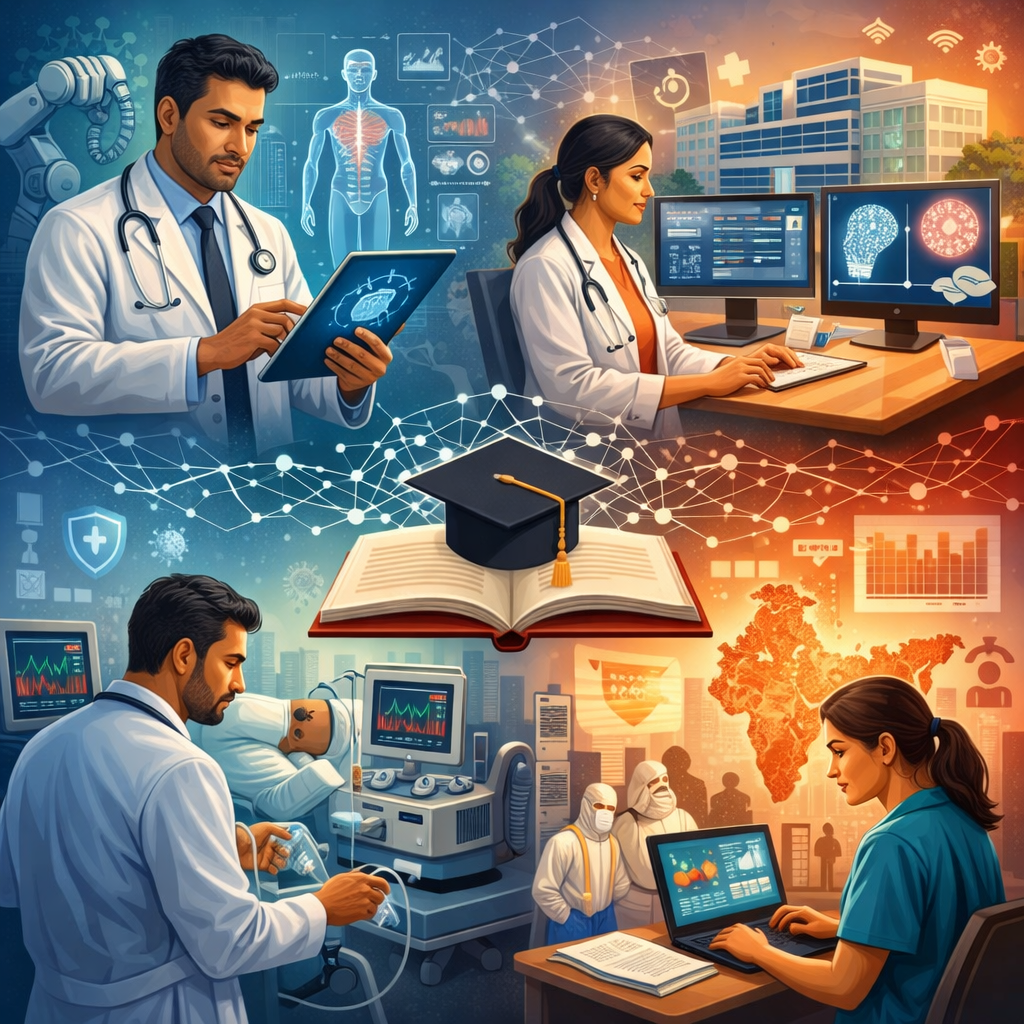
Healthcare is changing faster today than at any point in history. From AI-powered diagnostics to predictive analytics and smart hospitals, technology is transforming how doctors diagnose, treat, and manage patients.
But here is the truth:
Artificial Intelligence is not replacing doctors — it is reshaping the skills doctors need.
In this new environment, medical specialization courses are becoming essential for doctors who want to stay competitive, confident, and future-ready. Let’s understand why specialization is now the smartest career move in the AI-driven healthcare era.
The Rise of Artificial Intelligence in Healthcare
Artificial Intelligence is already integrated into everyday clinical practice:
- AI-assisted radiology interpretation
- Smart ICU monitoring systems
- Automated clinical documentation
- Predictive disease detection tools
- Digital hospital workflow management
- Remote patient monitoring platforms
According to recent reports, over 40% of clinicians in India are already using AI tools in their work, and adoption is increasing rapidly each year.
Additionally, AI-driven healthcare technologies are expected to contribute up to ₹2.6 lakh crore to India’s GDP by 2025, highlighting the scale of transformation underway.
This means one thing clearly:
Doctors who upgrade their expertise today will lead tomorrow’s healthcare system.
Why Doctors Must Adapt to the AI Era
Artificial Intelligence performs tasks like:
- Pattern recognition
- Data analysis
- Workflow automation
- Risk prediction
But it cannot replace:
- Clinical judgment
- Ethical decision-making
- Patient communication
- Emergency reasoning
- Holistic diagnosis
Instead, AI works best alongside specialized doctors, not generalists without domain expertise.
This is exactly where medical specialization courses become powerful career tools.
How Specialization Protects Doctors from AI Disruption
Rather than reducing opportunities, AI is increasing demand for doctors with focused expertise.
Here’s why.
1. Specialists Work With AI — Not Against It
AI systems assist specialists by:
- detecting complications earlier
- identifying disease patterns faster
- supporting treatment decisions
- improving patient monitoring accuracy
For example:
A doctor trained in diabetology can use AI glucose trend analysis tools more effectively than a general practitioner without specialization.
Specialization strengthens clinical interpretation of AI-generated insights.
2. Smart Hospitals Prefer Specialized Doctors
Modern hospitals are becoming:
- digital-first
- data-driven
- workflow-optimized
- AI-supported environments
Hospital administrators increasingly recruit doctors who understand:
- clinical pathways
- electronic health records
- disease protocols
- multidisciplinary coordination
Programs like Masters in Hospital Administration prepare doctors to lead AI-enabled healthcare systems rather than just work inside them.
3. Preventive Healthcare Is Expanding Rapidly
Artificial Intelligence is shifting healthcare from treatment-based care to prediction-based care.
This creates massive demand for specialists in:
- family medicine
- public health
- diabetes care
- critical care monitoring
Doctors trained in preventive specialties become essential in AI-powered healthcare ecosystems.
4. AI Cannot Replace Human Clinical Context
AI can detect patterns.
Doctors understand patients.
Example:
AI may identify abnormal glucose levels.
A trained diabetologist understands:
- lifestyle factors
- medication interactions
- socioeconomic conditions
- compliance challenges
This human intelligence makes specialization irreplaceable.
Why India Especially Needs Specialized Doctors in the AI Age
India is uniquely positioned for rapid healthcare transformation.
Reasons include:
- rising patient load
- digital health expansion
- telemedicine growth
- smart hospital adoption
- National Digital Health Mission implementation
At the same time, India still faces a shortage of trained specialists across multiple healthcare domains.
AI tools improve efficiency — but they increase demand for trained experts who can interpret outputs correctly.
This creates strong career opportunities for doctors who pursue specialization today.
Medical Specialization Courses That Are Highly Relevant in the AI Era
Doctors who choose the right specialization can future-proof their careers.
Some of the most relevant programs include:
PG Diploma in Diabetology
AI is revolutionizing diabetes care through:
- continuous glucose monitoring analytics
- complication prediction models
- personalized treatment algorithms
Trained diabetologists will lead next-generation metabolic care.
PG Diploma in Family Medicine
Family physicians are becoming central to:
- preventive healthcare
- telemedicine services
- community-level AI screening programs
- chronic disease monitoring
Family medicine specialists are essential in digital primary care ecosystems.
Fellowship in Critical Care Medicine
ICUs are among the most technology-driven hospital departments today.
AI-enabled ICUs support:
- ventilator optimization
- early deterioration alerts
- sepsis prediction
- real-time monitoring dashboards
Critical care specialists trained in modern systems are in extremely high demand.
Masters in Hospital Administration
Future hospitals will be data-driven organizations.
Hospital administrators must understand:
- AI workflow automation
- digital patient pathways
- predictive resource allocation
- smart healthcare logistics
This specialization prepares doctors for leadership roles in smart hospitals.
Masters in Public Health (MPH)
AI is transforming population health through:
- disease surveillance
- outbreak prediction
- vaccination strategy modeling
- epidemiological analytics
Public health professionals trained today will shape tomorrow’s national healthcare strategies.
AI Will Reward Skilled Doctors — Not Replace Them
A common concern among doctors is:
“Will AI take my job?”
The real answer is:
AI will replace routine workflows — not skilled specialists.
Doctors who upgrade their qualifications:
✔ stay competitive
✔ improve career stability
✔ access leadership roles
✔ work with advanced healthcare systems
✔ increase earning potential
Specialization is no longer optional. It is becoming essential.
How AIHMS Helps Doctors Stay Future-Ready
Athar Institute of Health and Management Studies offers industry-relevant specialization programs designed for working medical professionals who want to grow in evolving healthcare environments.
Programs are structured to help doctors:
- upgrade clinical expertise
- enter high-demand specialties
- adapt to modern healthcare technologies
- improve career flexibility
- move into leadership roles
Whether your interest lies in clinical specialization, hospital leadership, or public health systems, the right course can prepare you for the AI-enabled future of medicine.
Final Thoughts
Artificial Intelligence is not the future of healthcare.
It is the present.
Doctors who combine clinical specialization with technological awareness will lead the next decade of medical practice in India.
If you want to remain relevant, respected, and ready for tomorrow’s healthcare challenges, this is the right time to invest in medical specialization.
Because in the AI era, the most successful doctors will not be those who resist change — but those who prepare for it. 🚀
