
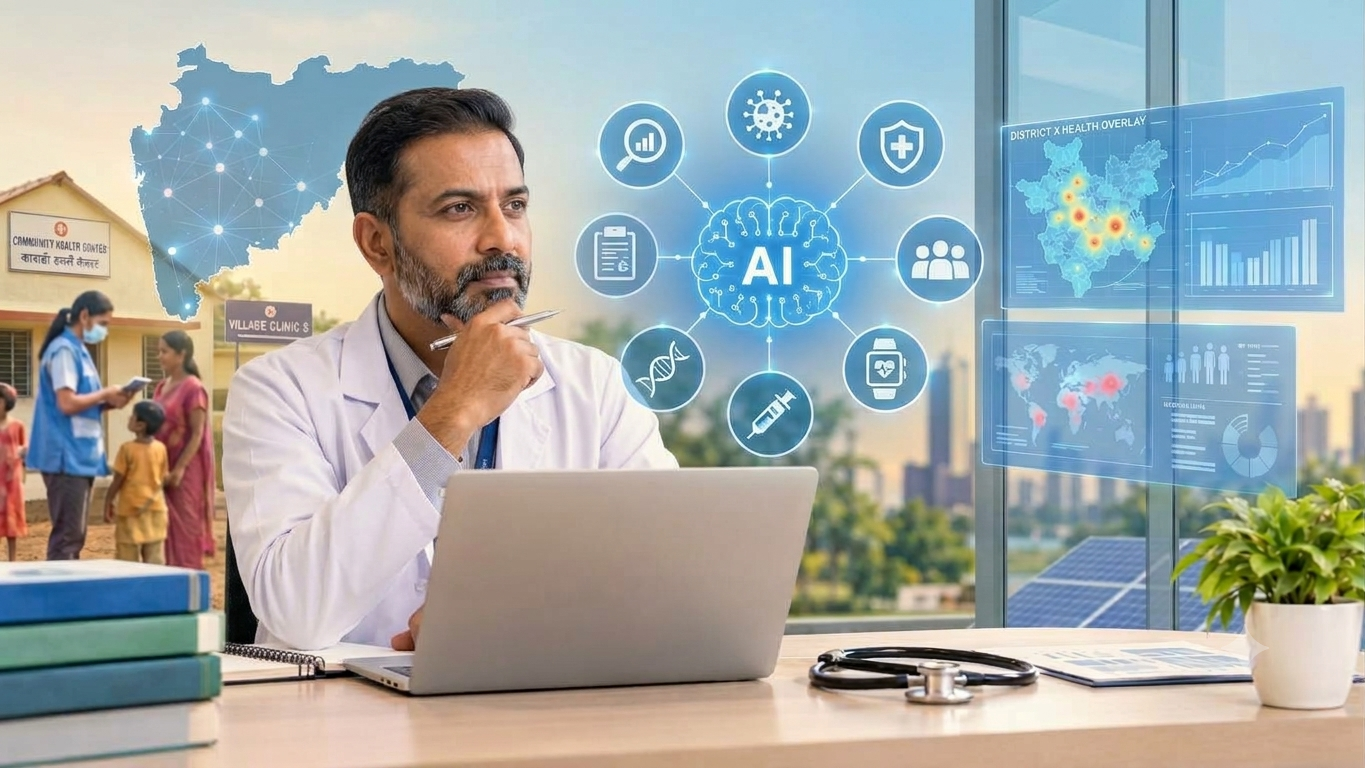
Artificial Intelligence (AI) is creating new possibilities in public health by helping professionals analyse health data, monitor disease outbreaks, identify population-level risks and plan healthcare interventions. From predicting seasonal disease patterns to evaluating vaccination programmes, AI-powered tools can support decisions that once required extensive manual data analysis.
For public health professionals in India, these developments are particularly relevant. Large populations, regional differences in healthcare access, infectious diseases, rising rates of diabetes and cardiovascular disease, and shortages of healthcare resources make effective planning essential. AI can help public health teams understand these challenges and identify where interventions may be needed most.
However, technology alone cannot solve public health problems. Successful interventions require scientific knowledge, community engagement, ethical decision-making and an understanding of how health policies work in practice.
This is where professionals with a Master of Public Health (MPH) qualification can play an important role. By combining public health expertise with AI literacy, MPH graduates can contribute to disease prevention, health research, programme management and evidence-based policymaking.
What Is the Role of AI in Public Health?
Public health focuses on protecting and improving the health of entire populations rather than treating individual patients alone. It includes disease surveillance, epidemiology, health promotion, environmental health, health policy and the evaluation of healthcare programmes.
AI refers to technologies that can identify patterns in data, generate predictions, process language and assist with specific analytical tasks. In public health, these capabilities can help professionals process large datasets, detect emerging trends and organise information for decision-making.
For example, a public health department may need to understand why dengue cases are increasing in certain districts. AI-assisted analysis can help examine historical case numbers, rainfall, temperature, population density and other relevant factors. The findings may help teams identify areas that need closer monitoring.
Nevertheless, an AI-generated prediction is not proof that an outbreak will occur. Public health experts must validate the information, assess its limitations and combine it with local surveillance and field investigations.
The purpose of AI is to strengthen public health decisions, not replace the professionals responsible for making them.
7 Ways MPH Professionals Can Use Artificial Intelligence
1. Disease Surveillance and Outbreak Prediction
Early detection of infectious diseases is essential for limiting their spread. Traditional surveillance relies on reports from healthcare facilities, laboratories and public health workers. AI-assisted systems can analyse multiple data sources to identify unusual patterns that may require further investigation.
For instance, machine learning models may help identify changes in reported dengue, influenza or other infectious disease cases. Depending on the available data, models can also examine weather patterns, population movement and historical outbreaks.
MPH professionals trained in epidemiology can help design surveillance approaches, interpret model outputs and communicate findings to public health authorities.
Their responsibilities may include:
- Monitoring disease trends across geographical areas.
- Identifying unusual changes in reported cases.
- Supporting risk assessments and outbreak investigations.
- Helping public health teams prioritise surveillance activities.
- Evaluating whether prediction systems provide useful and reliable results.
AI predictions should always be interpreted alongside laboratory findings, clinical reports and established public health surveillance procedures.
2. Public Health Data Analysis
Public health decisions depend on reliable information. Professionals often work with survey results, demographic data, disease registries, hospital reports and community health indicators.
AI and machine learning tools can help identify patterns within these datasets. They may reveal associations between health outcomes and factors such as age, income, living conditions, nutrition or access to healthcare.
For example, an MPH graduate analysing maternal health data may investigate whether certain geographical areas experience higher rates of antenatal care gaps or institutional delivery barriers.
AI-assisted analysis can help identify patterns that deserve further investigation. Statistical methods and epidemiological reasoning are still needed to distinguish meaningful associations from misleading correlations.
MPH professionals who understand data quality, study design, statistics and interpretation can use these tools more effectively than those who rely on automated outputs alone.
3. Predicting Disease Risk and Supporting Prevention
Preventive healthcare aims to reduce the likelihood of illness before complications develop. AI can support this goal by helping public health teams identify population groups that may benefit from targeted interventions.
For example, models may help analyse patterns associated with diabetes, hypertension, cardiovascular disease or other chronic conditions. When appropriate data are available, these models can help estimate population-level risks and guide screening or health education strategies.
An MPH professional working on a non-communicable disease programme might use these insights to identify communities where screening access is limited or where preventive education needs strengthening.
However, risk predictions should not be used to label individuals unfairly or deny them services. Models may reflect existing inequalities in healthcare access and data collection. Human oversight is essential to ensure that interventions remain fair, appropriate and evidence-based.
4. Improving Public Health Programmes
Government departments, hospitals, NGOs and international health organisations implement programmes for immunisation, maternal health, nutrition, sanitation and disease prevention.
These programmes generate substantial information about participation, expenditure, service delivery and outcomes. AI-assisted analytics can help programme managers examine this information and identify areas that require attention.
Consider a vaccination programme in which coverage differs significantly between districts. Analytical tools may help identify patterns related to missed appointments, service availability or geographical access. Public health teams can then investigate the reasons and develop suitable interventions.
MPH professionals can use AI-assisted analysis to support programme planning, monitor implementation and evaluate whether activities are achieving their intended objectives.
The final decisions must account for local conditions, community feedback, available resources and the evidence supporting each intervention.
5. Health Communication and Community Awareness
Effective public health depends on communicating accurate information in a way that people can understand and act upon.
AI tools can help professionals prepare educational materials, summarise research findings, translate draft messages and adapt communication for different audiences. They can also assist in analysing common questions or concerns raised through public feedback channels.
For example, an MPH professional working on a diabetes awareness campaign may use AI to develop initial versions of educational content in Hindi or other regional languages. Public health experts should then review the material for medical accuracy, cultural suitability and readability before distribution.
AI-generated health communication can contain factual errors, inappropriate wording or misleading recommendations. Human review is especially important when messages concern vaccination, infectious diseases, treatment decisions or emergency situations.
6. Environmental Health and Climate-Related Risks
Environmental conditions influence population health. Air pollution, extreme heat, unsafe water, flooding and changing weather patterns can increase health risks and place additional pressure on healthcare services.
AI-assisted models can analyse environmental measurements alongside health data to help identify possible relationships and areas of concern.
For instance, public health teams may use temperature forecasts, air-quality information and hospital attendance patterns to support heat-health action plans. Environmental health professionals can also investigate whether certain communities face greater exposure because of housing conditions, occupation or limited access to cooling.
MPH graduates specialising in environmental health or epidemiology can contribute by interpreting the findings, identifying vulnerable populations and helping authorities plan preventive measures.
Such models are most useful when supported by reliable local data and validated against observed conditions.
7. Public Health Research and Evidence-Based Policy
Research helps policymakers understand which interventions work, which populations are underserved and where public resources should be directed.
AI can assist researchers with literature discovery, document organisation, preliminary data exploration and the summarisation of large collections of information. Depending on the method and dataset, machine learning can also support specific research tasks, such as identifying patterns in health records or examining trends across populations.
MPH professionals can use these tools to make research workflows more efficient while maintaining scientific standards.
AI does not remove the need for sound research methodology. Researchers must verify references, protect confidential information, account for bias and ensure that their conclusions are supported by the evidence. AI-generated text should never be treated as a substitute for reading important studies or conducting appropriate analysis.
Career Opportunities for MPH Graduates in AI-Driven Public Health
AI is creating opportunities for professionals who can connect population health knowledge with data analysis and digital technologies. An MPH qualification can provide a foundation for these roles, although specialist positions may require additional training or relevant experience.
Some potential career pathways include:
| Career pathway | How AI may be used |
|---|---|
| Epidemiology and disease surveillance | Identifying disease trends and supporting outbreak investigations |
| Public health data analysis | Analysing health indicators and identifying population-level patterns |
| Monitoring and evaluation | Tracking programme performance and examining outcomes |
| Digital health programme management | Supporting technology-enabled public health initiatives |
| Health policy and planning | Interpreting evidence to inform resource allocation and policy development |
| Environmental health | Analysing environmental exposures and potential health risks |
| Public health research | Supporting literature reviews, data exploration and research workflows |
| Global health programmes | Analysing programme data and monitoring health interventions |
These roles do not all require advanced AI programming skills. Some focus on programme implementation, research, policy or interpretation, while specialised data science positions may require knowledge of programming, statistics and machine learning.
For MPH students, the goal should be to develop the right combination of public health expertise and technical competence for their chosen career direction.
Essential AI Skills for MPH Students and Professionals
Learning to use AI effectively does not mean becoming a software engineer. Public health professionals need to understand how digital tools work, what questions they can answer and where their results may be unreliable.
1. Data Literacy and Statistics
A strong understanding of statistics is essential for interpreting public health findings. MPH students should become comfortable with indicators such as prevalence, incidence, mortality rates, risk ratios and confidence intervals.
They should also learn to distinguish correlation from causation and understand how missing or incomplete data can affect conclusions.
2. Epidemiology and Research Methods
AI tools are only as useful as the questions they are designed to answer. Knowledge of study design, sampling, confounding, bias and research ethics helps public health professionals evaluate whether a model or analytical method is appropriate.
3. Familiarity With Data Tools
Spreadsheet applications and data visualisation tools can help students organise information and communicate findings. Depending on their career goals, they may also benefit from learning statistical software, SQL, R or Python.
These skills can support more advanced work in public health analytics and machine learning.
4. Critical Evaluation of AI Outputs
AI-generated summaries, predictions and recommendations may contain errors. Professionals should verify important claims, check original sources and assess whether a result makes sense in the local public health context.
This is particularly important when working with disease surveillance, health policy and resource allocation.
5. Ethics, Privacy and Responsible Data Use
Public health data can contain sensitive personal information. Professionals must understand confidentiality, data minimisation, secure access, informed consent where applicable and the rules governing data use.
AI systems can also produce biased results if the data used to develop them do not adequately represent the population. MPH graduates should consider fairness, transparency and the possible consequences of automated recommendations.
Challenges of Using AI in Public Health
Although AI offers useful capabilities, implementation is not without difficulties. Public health professionals must understand its limitations before relying on it for planning or decision-making.
Poor data quality: Incomplete, outdated or inconsistent records can produce misleading results. Reliable data collection and validation remain fundamental.
Bias and health inequalities: Models trained on data from some populations may perform poorly for others. This can lead to unequal risk assessments or poorly targeted interventions.
Privacy and confidentiality: Health information must be protected through appropriate security measures, access controls and lawful data-handling practices.
Limited technical infrastructure: Some areas may lack reliable internet access, suitable hardware, trained personnel or integrated digital records. These limitations can affect implementation.
Difficulty interpreting predictions: A model may identify a pattern without explaining its underlying cause. Public health professionals must determine what the findings mean and whether an intervention is justified.
Overdependence on automation: Treating AI recommendations as automatically correct can undermine professional judgement and lead to inappropriate decisions.
Implementation costs: Software, training, maintenance, data governance and system integration all require resources. Organisations must evaluate whether a proposed AI application provides meaningful benefits.
Addressing these challenges requires collaboration between public health experts, statisticians, data scientists, policymakers, healthcare providers and affected communities.
AI in Public Health in India: Why It Matters
India’s public health priorities include infectious disease control, maternal and child health, nutrition, non-communicable diseases, environmental health and equitable access to healthcare.
AI may support these priorities by helping teams analyse surveillance information, identify service gaps and improve programme monitoring. For example, data-driven tools could assist with understanding variations in immunisation coverage, identifying potential disease hotspots or evaluating the reach of health education campaigns.
However, the usefulness of these applications depends on the availability of reliable data, appropriate validation, adequate infrastructure and trained professionals who understand the communities being served.
Public health problems are rarely solved by prediction alone. A model may identify a district with a high disease burden, but reducing that burden can require trained field workers, accessible health facilities, community trust, sufficient funding and effective public policy.
This is why MPH professionals remain important. Their understanding of epidemiology, health systems, programme management and social determinants of health can help translate analytical findings into practical interventions.
How an MPH Course Can Prepare You for the Future of Public Health
Students considering a Master of Public Health should look for a programme that builds strong foundations in epidemiology, biostatistics, health policy, research methodology and programme management.
These subjects provide the knowledge needed to interpret AI-generated findings rather than simply operate digital tools.
Practical learning is also valuable. Research projects, fieldwork, internships and programme evaluation exercises can help students understand the challenges of working with real-world health information.
Students interested in AI-enabled careers can complement their MPH education by learning data visualisation, statistical analysis, digital health systems and introductory programming. They should also develop skills in scientific writing, communication and ethical decision-making.
The combination of public health knowledge and digital literacy can help graduates explore opportunities across government health programmes, NGOs, research institutions, hospitals, consulting organisations and digital health initiatives. Specific roles depend on eligibility, experience and employer requirements.
The aim is to become a public health professional who can ask meaningful questions, evaluate evidence and use technology responsibly to improve population health.
Study Master of Public Health at AIHMS
For students who want to build a career in public health, choosing the right educational programme is an important step. A well-structured MPH programme can help students understand population health challenges, research methods, health systems and the planning of public health interventions.
The Athar Institute of Health and Management Studies (AIHMS) offers a Master of Public Health programme for students interested in developing their knowledge of public health and healthcare systems.
As AI becomes more relevant to disease surveillance, health research and programme evaluation, aspiring public health professionals can complement their academic learning with digital skills and an understanding of responsible AI use.
Students can explore the programme and review its eligibility requirements and course details on the official website:
Explore MPH at AIHMS: https://www.aihms.in/masters-in-public-health.html
Prospective students should review the programme curriculum, university affiliation, practical learning opportunities and degree-awarding arrangements before applying.
Conclusion: AI Will Support Public Health Professionals, Not Replace Their Expertise
Artificial Intelligence is changing how public health professionals analyse data, monitor diseases, plan interventions and evaluate healthcare programmes. From outbreak surveillance and environmental health to research and policy development, AI offers tools that can help professionals work with complex information more efficiently.
However, better predictions do not automatically produce healthier communities. Effective public health requires scientific understanding, ethical judgement, reliable evidence, community participation and the ability to implement appropriate interventions.
For MPH students and graduates, the opportunity lies in combining traditional public health competencies with data literacy, digital health knowledge and responsible AI use.
Those who understand both the science of population health and the capabilities of emerging technologies can contribute to more informed planning and potentially more effective public health programmes.
The future of public health will require professionals who can turn data into evidence, evidence into action, and technology into meaningful improvements in people’s lives.
Frequently Asked Questions
1. How is AI used in public health?
AI can support disease surveillance, outbreak prediction, public health data analysis, environmental health monitoring, programme evaluation, research and health communication.
2. Can MPH graduates work in AI and public health?
Yes. MPH graduates can explore roles involving public health analytics, epidemiology, digital health programmes, monitoring and evaluation, research and health policy. Specialised AI or data science positions may require additional technical training.
3. Do MPH students need coding skills to learn AI?
Not for every application. Basic AI literacy, statistics and data interpretation are useful starting points. Students interested in technical analytics or machine learning roles may benefit from learning R, Python, SQL or other relevant tools.
4. What are the benefits of AI in public health?
AI can help analyse large datasets, identify emerging patterns, support resource planning and improve the efficiency of certain research and monitoring tasks. Its benefits depend on data quality, validation and appropriate implementation.
5. What are the risks of AI in public health?
Major concerns include biased predictions, inaccurate outputs, privacy breaches, poor data quality, limited transparency and overreliance on automated recommendations.
6. Is an MPH useful for a career in digital public health?
An MPH can provide a foundation in epidemiology, biostatistics, health policy and programme management. Additional digital and analytical skills can help graduates pursue relevant opportunities in digital public health.
