
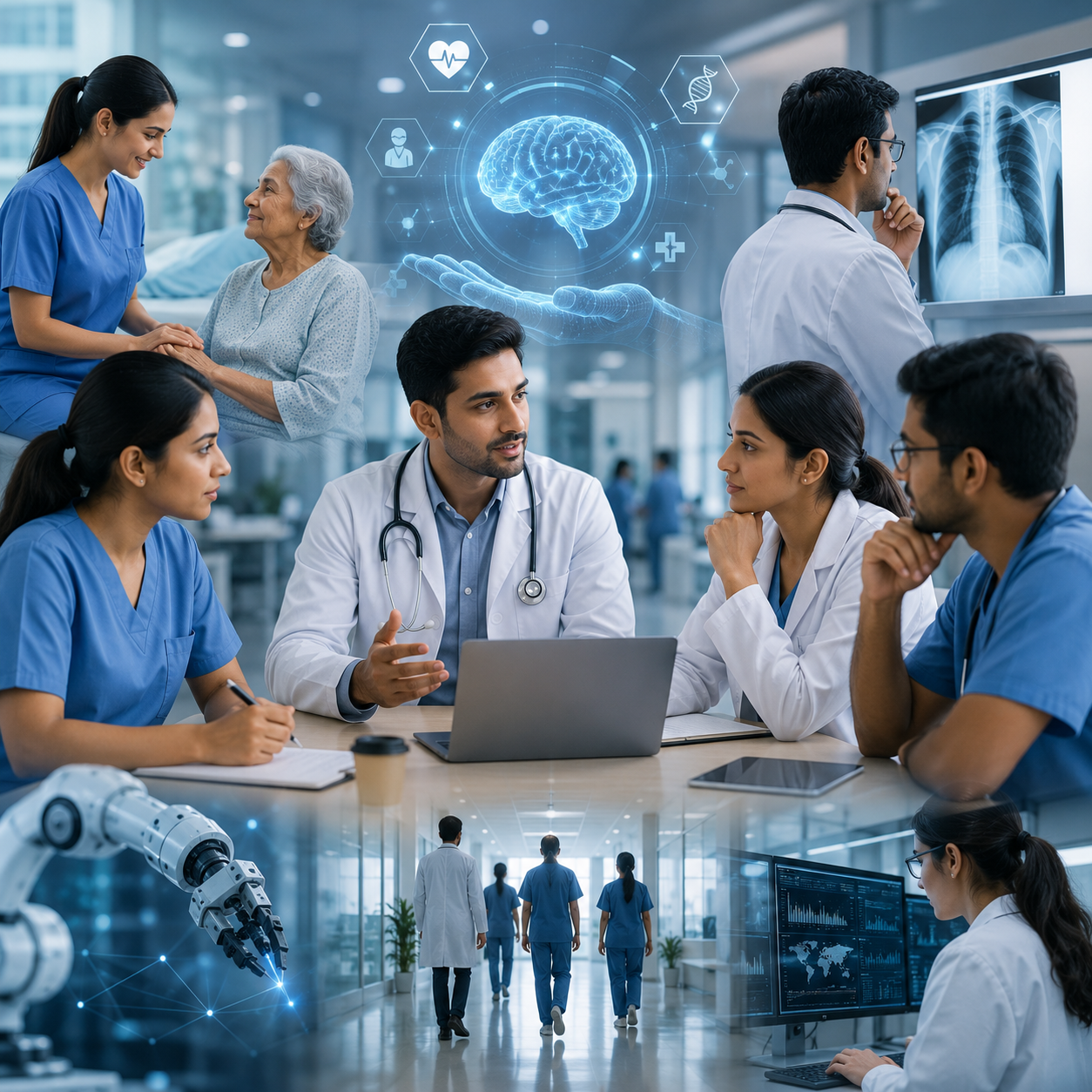
Artificial intelligence is changing healthcare faster than many people expected.
AI can analyze medical images, summarize clinical information, identify patterns in large datasets, automate administrative tasks, assist with documentation, and support clinical decision-making. New healthcare technologies are appearing almost every year, and it is natural for medical students and healthcare professionals to wonder:
Will AI eventually replace healthcare jobs?
The more realistic answer is that AI is likely to change many healthcare jobs rather than simply eliminate them.
Healthcare is not only about diagnosing a disease or processing information. It is also about understanding people, communicating difficult information, making decisions in uncertain situations, building trust, coordinating teams, handling emergencies, and taking responsibility for patient care.
These are areas where human skills remain extremely valuable.
For doctors, nurses, hospital administrators, public health professionals, and healthcare managers, the goal should not be to compete with AI at tasks where machines are good.
Instead, healthcare professionals should develop the skills where human judgement, empathy, communication, leadership, and accountability matter most.
Here are some of the healthcare skills that are likely to remain highly valuable in an AI-driven healthcare system.
1. Empathy and Emotional Intelligence
A machine can recognize words associated with sadness, anxiety, or fear. But understanding what a patient is experiencing as a human being is much more complex.
A patient receiving a cancer diagnosis, a parent worried about a child’s illness, or an elderly person struggling with multiple health problems needs more than information.
They need someone who can listen.
Empathy allows healthcare professionals to understand the emotional side of illness.
Doctors and nurses may need to:
- Listen to patient concerns
- Recognize anxiety
- Understand family dynamics
- Respond sensitively to difficult situations
- Provide reassurance when appropriate
- Respect cultural and personal preferences
- Support patients through uncertainty
AI may assist with communication, but genuine human connection remains an essential part of healthcare.
2. Communication Skills
Healthcare professionals communicate constantly.
They speak with patients, relatives, nurses, specialists, administrators, laboratory teams, pharmacists, insurance representatives, and many others.
Good communication is not simply about providing correct information.
It involves understanding how to communicate that information.
For example, explaining a complicated medical condition to a patient requires a very different approach from discussing the same condition with another doctor.
Strong healthcare communication includes:
- Active listening
- Clear explanations
- Asking the right questions
- Avoiding unnecessary medical jargon
- Managing difficult conversations
- Explaining risks and benefits
- Communicating with families
- Handling misunderstandings
AI can generate information, but healthcare professionals still need to decide what the patient needs to hear, how they should hear it, and when the conversation needs a human touch.
3. Clinical Judgement
AI can identify patterns from large amounts of data.
But healthcare decisions are rarely based on one piece of information.
A doctor may need to consider:
- Symptoms
- Medical history
- Physical findings
- Laboratory results
- Imaging
- Patient preferences
- Existing conditions
- Medication history
- Social circumstances
- Potential risks
Sometimes the available information is incomplete.
The doctor must make a decision despite uncertainty.
This is where clinical judgement becomes extremely important.
AI can provide recommendations or identify possibilities, but healthcare professionals need to evaluate whether those recommendations actually make sense for the individual patient.
4. Critical Thinking
Healthcare professionals cannot blindly accept information from any source—including AI.
AI systems can produce incorrect, incomplete, outdated, or inappropriate information.
Therefore, professionals need strong critical-thinking skills.
A healthcare professional should be able to ask:
Does this information make sense?
Is the evidence reliable?
Does it apply to this patient?
What information might be missing?
What could go wrong if this recommendation is followed?
The more AI becomes integrated into healthcare, the more important critical thinking may become.
Healthcare professionals will increasingly need to evaluate AI-generated information rather than simply consume it.
5. Ethical Decision-Making
Healthcare decisions can involve difficult ethical questions.
For example:
- Who should receive a limited medical resource?
- How should patient data be used?
- When should AI recommendations be ignored?
- How much information should a patient receive?
- How should patient consent be handled?
- Who is responsible when an AI-supported decision goes wrong?
These questions cannot always be answered by an algorithm.
Healthcare professionals need to understand ethical principles and consider the individual circumstances surrounding each case.
AI can support decision-making, but responsibility for ethical healthcare cannot simply be handed over to a machine.
6. Building Patient Trust
Trust is one of the foundations of healthcare.
Patients often share extremely personal information with healthcare professionals.
They need confidence that their doctor or healthcare team:
- Understands their concerns
- Will protect their privacy
- Will listen to them
- Will explain treatment options honestly
- Will act in their best interests
Technology can improve convenience, but trust is built through human interaction.
A patient may use an AI chatbot to ask a general health question, but many patients still want a qualified professional when making important decisions about their health.
7. Leadership
Healthcare is a team-based profession.
Hospitals bring together doctors, nurses, pharmacists, technicians, administrators, engineers, IT professionals, support staff, and many other professionals.
Someone has to coordinate these people.
That requires leadership.
Healthcare leaders need to:
- Set goals
- Build teams
- Resolve conflicts
- Make difficult decisions
- Motivate employees
- Manage change
- Communicate a vision
- Take responsibility
AI can provide data to leaders.
It cannot replace the human responsibility of leading people through complex situations.
This is particularly important for professionals pursuing Hospital Administration and Healthcare Management.
8. Teamwork and Collaboration
Modern healthcare rarely depends on a single professional.
A complex patient may require collaboration between multiple specialists and healthcare departments.
Effective teamwork involves understanding different perspectives and coordinating people toward a common objective.
Healthcare professionals need to know:
- When to ask for help
- How to delegate
- How to communicate with another department
- How to handle disagreement
- How to coordinate patient care
- How to share information appropriately
AI can support collaboration by organizing information, but human teamwork remains essential.
9. Adaptability
Ironically, one of the most important skills in an AI-driven healthcare industry may be the ability to adapt to change.
Healthcare professionals may encounter:
- New AI tools
- New hospital software
- New clinical technologies
- New digital workflows
- New regulations
- New healthcare delivery models
- New patient expectations
A professional who refuses to learn new technology may eventually struggle.
The answer is not to avoid AI.
It is to learn how to work with it.
Adaptability means being willing to learn, experiment, evaluate new systems, and change established processes when better approaches become available.
10. Problem-Solving in the Real World
Healthcare problems are often messy.
A hospital may have a technically excellent system but still face:
- Staff shortages
- Patient complaints
- Communication problems
- Delayed investigations
- Overcrowded departments
- Equipment issues
- Budget constraints
- Workflow bottlenecks
A computer may identify a pattern, but implementing a practical solution requires understanding the people and environment involved.
Healthcare professionals often need to combine information from multiple sources and find solutions that actually work in the real world.
That is human problem-solving.
11. Managing Difficult Conversations
Some healthcare conversations cannot be reduced to a script.
Doctors may need to discuss:
- Serious diagnoses
- Treatment limitations
- Poor prognoses
- End-of-life decisions
- Medical errors
- Treatment risks
- Lifestyle changes
- Unexpected complications
These conversations require sensitivity, timing, emotional awareness, and judgement.
A healthcare professional needs to understand not only what to say, but also when to pause, when to listen, and when the patient needs emotional support rather than more information.
12. Cultural and Social Understanding
Healthcare does not happen in isolation.
A patient’s beliefs, family structure, financial situation, education, language, occupation, and social environment can influence healthcare decisions.
Two patients with the same medical condition may make completely different choices.
Healthcare professionals need to understand these differences without making assumptions.
Human professionals can build relationships and understand context in ways that are difficult to fully capture through standardized algorithms.
13. Physical and Hands-On Clinical Skills
Some healthcare work requires direct physical interaction.
Examples include:
- Physical examination
- Surgery
- Procedures
- Wound care
- Rehabilitation
- Emergency interventions
- Patient positioning
- Bedside nursing care
Robotic and automated technologies may assist healthcare professionals in some of these activities, but they still require human oversight and clinical responsibility.
The physical side of healthcare remains an important limitation on the idea that AI alone can replace healthcare professionals.
14. Creativity
Healthcare professionals sometimes need to think beyond standard solutions.
A doctor may encounter an unusual presentation.
A hospital administrator may need to redesign a failing process.
A public health professional may need to develop a new strategy for reaching an underserved population.
A healthcare entrepreneur may need to design a new service.
Creativity involves generating and evaluating new ideas.
AI can assist brainstorming and analysis, but healthcare professionals still need to determine whether a new idea is clinically appropriate, practical, ethical, and useful.
15. Patient Advocacy
A healthcare professional is not simply responsible for providing medical information.
They may also advocate for the patient.
This can include helping patients:
- Understand treatment options
- Access appropriate services
- Navigate the healthcare system
- Communicate their concerns
- Receive appropriate follow-up
- Understand their rights
Patient advocacy requires understanding the individual rather than treating the patient as simply a collection of medical data.
16. Accountability and Professional Responsibility
Perhaps one of the most important differences between AI and healthcare professionals is accountability.
If an AI system produces a recommendation, someone still needs to evaluate it before it is used in an appropriate clinical context.
Healthcare professionals have professional responsibilities toward patients.
They need to understand:
- Their scope of practice
- Professional standards
- Patient safety
- Confidentiality
- Documentation
- Appropriate use of technology
- When to seek additional expertise
AI may support healthcare decisions, but responsibility for professional practice remains a human concern.
17. Crisis Management
Some healthcare situations change within minutes.
Examples include:
- Medical emergencies
- Mass-casualty incidents
- Hospital disasters
- Disease outbreaks
- Critical staffing shortages
- Infrastructure failures
During a crisis, healthcare professionals need to prioritize, communicate, improvise, coordinate teams, and make decisions under pressure.
Technology can provide valuable information, but crisis leadership requires people who can respond to rapidly changing circumstances.
18. Healthcare Management
AI may automate many administrative tasks, but this does not mean healthcare management will disappear.
In fact, healthcare managers may increasingly need to understand AI and use it effectively.
Healthcare managers need skills in:
- Leadership
- Staff management
- Financial planning
- Quality improvement
- Patient experience
- Operations
- Strategy
- Communication
- Change management
AI can show a hospital administrator that patient waiting times have increased.
The administrator still needs to determine why, work with staff, redesign the process, and implement the solution.
This is why combining healthcare management + technology awareness may become increasingly valuable.
19. Public Health and Community Engagement
Public health professionals work with populations rather than only individual patients.
Their work may involve:
- Disease prevention
- Health education
- Epidemiology
- Community programs
- Health policy
- Health promotion
- Emergency preparedness
Technology can help analyze population-level data, but successful public health interventions often depend on understanding communities and building trust.
A technically perfect health program can fail if people do not trust it or cannot realistically use it.
20. Lifelong Learning
Medicine never stops changing.
New diseases emerge, treatment approaches evolve, technologies improve, and scientific evidence changes.
AI will accelerate this transformation.
The healthcare professionals who remain valuable will not necessarily be those who know everything today.
They will be those who continue learning tomorrow.
Lifelong learning can include:
- Continuing medical education
- Professional certifications
- Healthcare management education
- Digital health training
- Data literacy
- AI literacy
- Research
- Conferences
- Professional reading
The ability to learn may become more important than memorizing information.
The Skills AI May Actually Make More Valuable
It is easy to think about AI as a competitor.
But there is another way to look at it.
AI can potentially reduce the time healthcare professionals spend on repetitive tasks.
For example, if technology helps reduce administrative work, professionals may have more time for:
- Patient communication
- Complex decision-making
- Team leadership
- Quality improvement
- Research
- Patient education
- Strategic planning
In this sense, AI may actually increase the value of distinctly human skills.
AI Skills Will Also Become Essential for Healthcare Professionals
Being “human” does not mean ignoring technology.
Healthcare professionals of the future will probably need both human skills and digital skills.
Some useful AI-related abilities may include:
AI Literacy
Understand what AI can and cannot do.
Data Literacy
Know how to interpret healthcare data and recognize misleading results.
Digital Communication
Understand how patients interact with digital healthcare platforms.
Technology Evaluation
Be able to assess whether a new healthcare technology actually improves care.
AI Ethics
Understand privacy, bias, transparency, accountability, and responsible use of AI.
Human-AI Collaboration
Learn how to use AI as a tool while maintaining professional judgement.
The strongest healthcare professional may therefore not be human versus AI.
It may be human + AI.
Which Healthcare Professionals Should Develop These Skills?
These skills are relevant across almost every healthcare career.
Doctors
Clinical judgement, empathy, communication, decision-making, and patient trust will remain central.
Nurses
Patient care, communication, empathy, teamwork, and clinical observation remain essential.
Hospital Administrators
Leadership, negotiation, problem-solving, strategy, and change management will become increasingly important.
Public Health Professionals
Community engagement, policy thinking, communication, and population-level problem-solving will remain valuable.
Health Informatics Professionals
Their role may increasingly involve connecting technology with real-world healthcare needs.
Healthcare Managers
AI may provide better data, but managers will still need to lead people and implement change.
How Students Can Prepare for an AI-Driven Healthcare Career
Students do not need to become AI engineers to prepare for the future.
Instead, build a balanced skill set.
Step 1: Strengthen Your Healthcare Foundation
Understand healthcare systems, clinical workflows, patient care, and professional responsibilities.
Step 2: Improve Communication
Practice speaking clearly, listening actively, and explaining complex ideas simply.
Step 3: Learn Basic Data Skills
Understand spreadsheets, dashboards, statistics, and healthcare data.
Step 4: Develop Digital Literacy
Become comfortable with electronic health records, hospital information systems, telemedicine, and digital healthcare platforms.
Step 5: Learn About AI
Understand the basic concepts of AI and its applications in healthcare.
Step 6: Develop Leadership Skills
Learn how to manage teams, resolve conflicts, coordinate projects, and implement change.
Step 7: Stay Curious
Healthcare will continue changing. A willingness to learn will be one of your strongest career assets.
The Future Healthcare Professional Will Look Different
The healthcare professional of the future may not simply be a doctor, nurse, administrator, or analyst who occasionally uses technology.
Technology will become part of everyday healthcare.
A doctor may use AI to review information before seeing a patient.
A hospital administrator may use predictive analytics to plan staffing.
A public health professional may use data systems to monitor disease trends.
A nurse may work with remote monitoring technologies.
A health informatics professional may help connect clinical workflows with AI-powered systems.
But in each situation, human judgement remains important.
Frequently Asked Questions
Will AI replace doctors?
AI is more likely to transform many aspects of medical practice than completely replace doctors. Human clinical judgement, communication, accountability, physical examination, ethical decision-making, and patient relationships remain important.
What healthcare skills are difficult for AI to replace?
Empathy, communication, leadership, critical thinking, ethical decision-making, patient advocacy, teamwork, clinical judgement, creativity, and crisis management are among the skills that remain strongly dependent on human capabilities.
Will AI replace hospital administrators?
AI may automate some administrative and analytical tasks, but hospital administrators will continue to need leadership, strategic thinking, staff management, negotiation, problem-solving, and change-management skills.
Should medical students learn AI?
Yes. Medical students can benefit from developing basic AI and digital-health literacy so they understand how technology can support healthcare and where its limitations lie.
Is communication still important if AI can communicate with patients?
Yes. AI can assist with communication, but healthcare professionals still need to handle complex, emotional, ethical, and highly personal conversations.
Can AI make healthcare decisions independently?
AI systems may support clinical decision-making, but healthcare professionals need to evaluate their outputs appropriately and consider the patient’s individual circumstances, professional responsibilities, and applicable standards.
What is the most important skill for healthcare professionals in the AI era?
There is no single skill. A combination of clinical or healthcare knowledge, critical thinking, communication, adaptability, empathy, technology literacy, and sound judgement will be increasingly valuable.
Conclusion
AI is going to change healthcare.
There is little doubt about that.
But the future of healthcare does not have to be a competition between humans and machines.
AI can process enormous amounts of information. It can identify patterns, automate repetitive work, and support professionals with data-driven insights.
Human healthcare professionals bring something different.
They bring empathy, judgement, responsibility, leadership, communication, creativity, trust, and an understanding of the human experience of illness.
These qualities are not becoming less important because of AI.
In many cases, they may become more important.
For students and professionals planning a healthcare career, the smartest approach is therefore not to avoid AI. Learn it. Understand it. Use it responsibly.
At the same time, develop the skills that technology cannot easily reproduce.
The healthcare professional of tomorrow will not necessarily be the person who knows the most about AI. It may be the person who knows how to combine AI with excellent human healthcare.
