
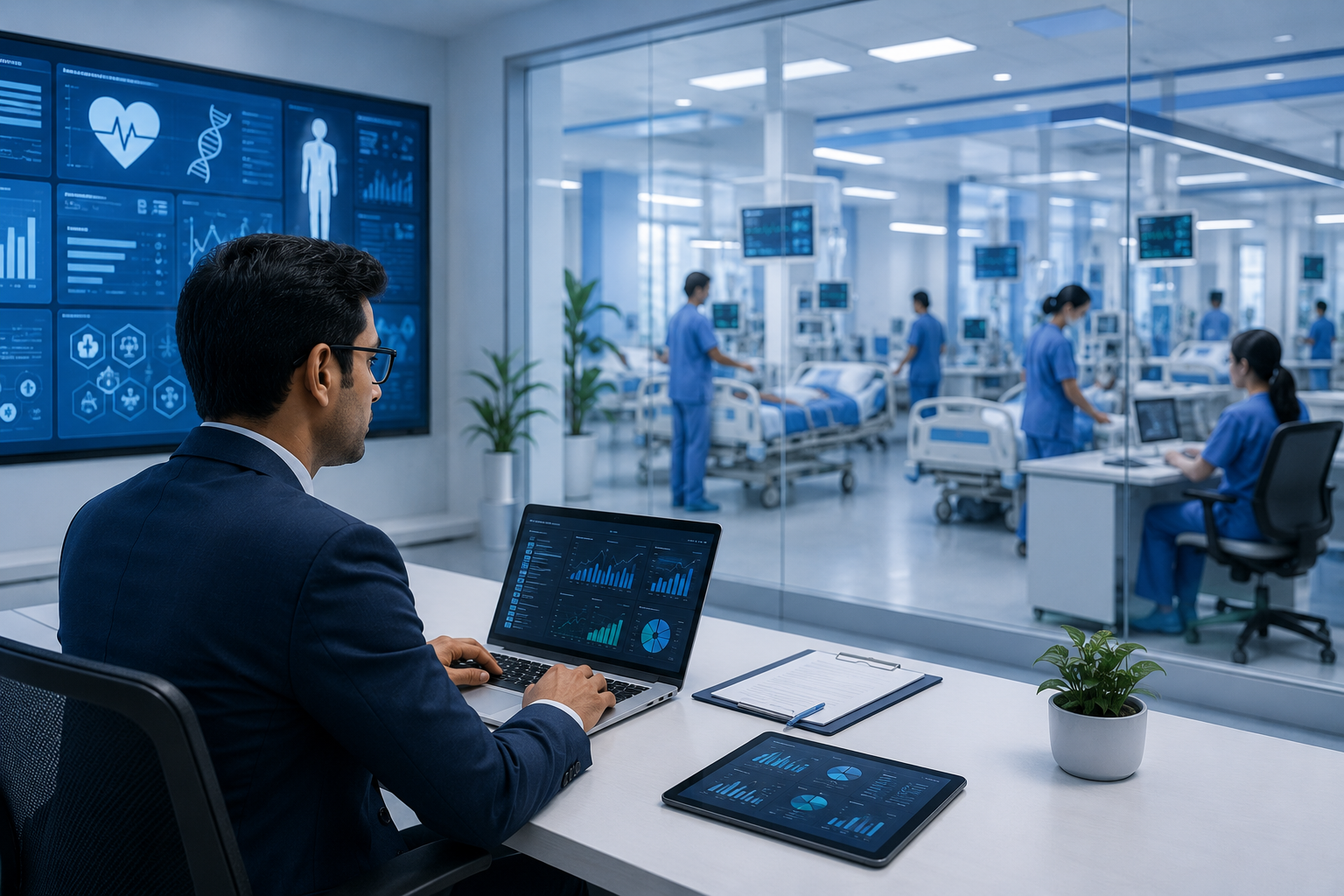
Hospitals are changing faster than ever.
A modern hospital is no longer defined only by its buildings, doctors, nurses, medical equipment, and number of beds. Increasingly, hospitals are becoming connected digital ecosystems where patient information, medical devices, staff, departments, and management systems work together.
Electronic health records, telemedicine, artificial intelligence, digital payments, smart medical devices, hospital information systems, automated workflows, data analytics, and remote monitoring are already changing how healthcare is delivered.
But technology alone cannot build a successful digital hospital.
People still have to manage the technology, teams, patients, processes, finances, quality, and day-to-day operations.
This is where the role of the hospital manager becomes even more important.
The hospital manager of the future will not simply manage hospital administration. They will increasingly need to understand technology, healthcare data, patient experience, cybersecurity, digital workflows, artificial intelligence, quality improvement, and strategic decision-making.
For healthcare professionals considering a career in hospital administration, this creates an important opportunity.
Let’s explore what the future of digital hospitals could look like and how hospital managers will need to adapt.
What Is a Digital Hospital?
A digital hospital uses technology and connected systems to improve the way healthcare is delivered and managed.
Instead of different departments operating through disconnected systems, digital hospitals aim to connect information and workflows across the organization.
A digital hospital may use:
- Electronic health records
- Hospital information systems
- Digital registration
- Electronic medical records
- Online appointment systems
- Telemedicine
- Digital diagnostic systems
- Automated pharmacy systems
- Smart medical devices
- Artificial intelligence
- Data analytics
- Digital payment systems
- Patient portals
- Remote patient monitoring
- Automated inventory management
- Digital quality monitoring
The goal is not simply to “use more technology.”
The real goal is to make healthcare more connected, efficient, safe, accessible, and patient-centered.
Why Are Hospitals Becoming More Digital?
Healthcare generates enormous amounts of information every day.
A single hospital may handle:
- Patient registrations
- Clinical records
- Laboratory reports
- Imaging
- Prescriptions
- Billing
- Insurance claims
- Pharmacy transactions
- Bed availability
- Staff schedules
- Inventory
- Quality indicators
- Patient feedback
Managing all of this manually becomes increasingly difficult as hospitals grow.
Digital systems can help organize this information and make it available to the right people at the right time.
For hospital managers, this means technology can become an important tool for better decision-making and operational control.
The Future Hospital Will Be More Connected
One of the biggest changes will be greater connectivity between hospital departments.
Imagine a patient arriving at a hospital.
Their appointment is already registered digitally.
The registration department can access the patient’s information.
The doctor records the consultation electronically.
The laboratory receives the test request digitally.
Test results are added to the patient’s record.
The pharmacy receives the prescription electronically.
The billing system records the relevant services.
The patient receives updates through a digital platform.
The hospital manager can monitor important operational indicators through dashboards.
The objective is to reduce unnecessary duplication and create a smoother flow of information.
Hospital Information Systems Will Become Even More Important
Hospital Information Systems, or HIS, are already an important part of healthcare administration.
In the future, these systems are likely to become increasingly sophisticated.
A hospital information system can connect areas such as:
- Registration
- OPD
- IPD
- Emergency
- Laboratory
- Radiology
- Pharmacy
- Billing
- Insurance
- Medical records
- Inventory
- Human resources
- Finance
- Quality management
For hospital managers, understanding these systems will become increasingly valuable.
They may not need to become software developers, but they should understand how healthcare technology works and how it affects hospital operations.
Artificial Intelligence Will Become a Management Tool
Artificial intelligence is likely to influence both clinical care and hospital administration.
AI may assist with tasks such as:
- Predicting patient demand
- Identifying operational bottlenecks
- Forecasting inventory requirements
- Supporting appointment scheduling
- Analyzing patient feedback
- Detecting unusual patterns in data
- Supporting documentation
- Improving workflow management
- Assisting resource planning
For example, a hospital may use historical data to estimate patient volumes during different periods.
A manager could use that information to plan:
- Staffing
- Beds
- Medical supplies
- Laboratory capacity
- Emergency resources
The manager’s role would not disappear.
Instead, the manager would need to interpret the information and make decisions based on it.
AI Will Not Replace Hospital Managers
This is one of the most important points.
Technology can process information.
It can identify patterns.
It can automate repetitive tasks.
But hospital management involves much more than processing information.
Hospital managers deal with:
- People
- Conflicts
- Doctors
- Nurses
- Patients
- Families
- Vendors
- Regulators
- Financial constraints
- Emergencies
- Ethical issues
- Organizational culture
These situations often require judgement, communication, negotiation, empathy, and leadership.
The future is therefore unlikely to be:
AI vs Hospital Manager
It is more likely to be:
Hospital Manager + AI
Managers who understand how to use technology effectively may have an advantage over those who ignore it.
Data Will Become One of the Most Valuable Hospital Assets
Hospitals produce large amounts of data.
But data has little value if nobody can understand or use it.
Future hospital managers will increasingly need to ask:
- What is our average length of stay?
- Which departments have the highest patient load?
- Where are delays occurring?
- How efficiently are beds being used?
- Which services are generating bottlenecks?
- What are patients complaining about?
- Where are costs increasing?
- Which processes can be improved?
Dashboards and analytics can help answer these questions.
This means data literacy will become an important management skill.
Hospital Managers Will Need to Understand Healthcare Analytics
Healthcare analytics involves using data to identify patterns and support better decisions.
For example, analytics can help a hospital understand:
Patient flow
Where do patients spend the most time?
Bed utilization
How effectively are available beds being used?
Readmission patterns
Are certain groups of patients returning more frequently?
Operational efficiency
Where are delays occurring?
Financial performance
Which processes are increasing costs?
Patient experience
What issues are patients reporting?
A manager who can understand these indicators can make more informed decisions.
Predictive Analytics Could Change Hospital Planning
Traditional management often looks at what happened yesterday.
Predictive analytics attempts to answer:
What might happen next?
For example, a hospital could potentially use historical information to forecast:
- Patient demand
- Emergency department volumes
- Seasonal disease patterns
- Bed requirements
- Staffing needs
- Inventory consumption
This could help managers move from reactive management toward proactive planning.
Instead of waiting for a problem to occur, managers can prepare for likely scenarios.
Smart Hospitals Will Use Connected Medical Devices
The Internet of Medical Things is another area that could influence future hospitals.
Medical devices can increasingly generate and transmit information.
Examples include:
- Patient monitors
- Smart infusion systems
- Wearable devices
- Connected diagnostic equipment
- Remote monitoring devices
Connected systems can potentially allow information to move more efficiently between devices and hospital platforms.
For managers, this creates opportunities—but also responsibilities.
They will need to think about:
- Device integration
- Data security
- Staff training
- Maintenance
- Procurement
- Cost-effectiveness
- Patient safety
Telemedicine Will Remain Part of the Healthcare Ecosystem
Digital hospitals will not necessarily be limited to physical hospital buildings.
Telemedicine allows healthcare providers to interact with patients remotely when clinically appropriate.
Hospitals can use digital services for:
- Follow-up consultations
- Remote monitoring
- Specialist consultations
- Second opinions
- Chronic disease management
- Patient education
This creates a broader concept of hospital operations.
The hospital of the future may serve patients inside the building and outside it.
Hospital managers will need to coordinate both physical and digital services.
Remote Patient Monitoring Could Change Hospital Operations
Remote monitoring can allow certain patients to have health information collected outside the hospital.
For suitable patients, technology may monitor information such as:
- Heart rate
- Blood pressure
- Blood glucose
- Oxygen levels
- Activity
- Other health indicators
The hospital may receive this information through digital platforms.
This could support earlier intervention in some situations and potentially reduce unnecessary hospital visits.
But successful implementation requires more than buying devices.
Managers must establish:
- Workflows
- Responsibilities
- Escalation procedures
- Data security
- Staff training
- Patient education
Digital Patient Experience Will Become More Important
Patients increasingly expect convenience.
They may want to:
- Book appointments online
- Receive reminders
- Access reports digitally
- Make online payments
- Communicate with healthcare teams
- Track appointments
- Receive prescriptions electronically
This means patient experience will increasingly include digital experience.
A hospital can have excellent doctors but still frustrate patients if:
- Appointment systems are confusing
- Patients wait unnecessarily
- Reports are difficult to access
- Communication is poor
- Billing processes are complicated
Hospital managers will need to consider the entire patient journey.
Digital Hospitals Will Need Stronger Cybersecurity
The more digital a hospital becomes, the more important cybersecurity becomes.
Hospitals handle sensitive information such as:
- Patient identities
- Medical histories
- Diagnostic reports
- Prescriptions
- Financial information
- Insurance information
A cybersecurity incident can affect both operations and patient trust.
Future hospital managers therefore need at least a basic understanding of:
- Data protection
- Access controls
- Cybersecurity policies
- Staff awareness
- Incident response
- Backup systems
- Digital risk management
Managers do not need to become cybersecurity engineers.
But they need to understand why cybersecurity is a management responsibility.
Digital Transformation Will Change Hospital Staff Roles
Technology can automate some repetitive activities.
For example:
- Manual data entry
- Appointment reminders
- Inventory alerts
- Certain billing processes
- Report distribution
- Administrative documentation
But automation does not necessarily mean fewer people everywhere.
Instead, staff responsibilities may change.
Employees may spend less time performing repetitive administrative work and more time on:
- Patient interaction
- Problem-solving
- Quality improvement
- Coordination
- Decision support
Hospital managers will need to manage this transition carefully.
Change Management Will Become a Critical Skill
Introducing new technology into a hospital is rarely simple.
A hospital may purchase an advanced system, but if employees do not use it properly, the investment may fail.
Common challenges include:
- Resistance to change
- Lack of training
- Poor communication
- Workflow disruption
- Technical problems
- Confusion about responsibilities
This is why future hospital managers need strong change-management skills.
They need to answer:
Why are we introducing this system?
How will it help staff?
How will it affect patients?
What training is required?
How will we measure success?
Technology implementation is therefore as much a people-management challenge as a technical challenge.
Hospital Managers Will Become Technology-Enabled Leaders
The traditional hospital manager may have focused heavily on:
- Administration
- Staff coordination
- Finance
- Operations
- Patient services
The future manager will still need these skills.
But additional knowledge will become valuable:
- Digital health
- Data analytics
- AI
- Hospital information systems
- Cybersecurity
- Telemedicine
- Process automation
- Digital patient experience
This does not mean every hospital manager needs to become a technology expert.
It means they need to become technology-aware leaders.
Quality Management Will Become More Data-Driven
Quality improvement is another area where digital systems can make a major difference.
Instead of relying entirely on manual reports, hospitals can use digital dashboards to monitor indicators.
Examples include:
- Patient waiting time
- Length of stay
- Readmission rates
- Patient complaints
- Infection indicators
- Medication errors
- Staff performance
- Patient satisfaction
Managers can then identify areas requiring improvement.
The process becomes:
Measure → Analyze → Improve → Monitor
This creates a more continuous approach to healthcare quality.
Digital Technology Can Improve Resource Management
Hospitals have limited resources.
They need to manage:
- Beds
- Staff
- Equipment
- Medicines
- Supplies
- Operating rooms
- Laboratory capacity
- Finances
Digital systems can provide managers with better visibility into resource utilization.
For example, an inventory system can help identify when supplies are running low.
A bed-management system can provide information about availability.
Staff scheduling tools can help coordinate workforce requirements.
The technology does not make the decision by itself.
The manager still needs to determine what action should be taken.
The Future Hospital Manager Will Need Strong Communication Skills
It may seem strange to discuss communication in an article about digital hospitals.
But technology actually makes communication more important.
A hospital manager may have to communicate with:
- Doctors
- Nurses
- IT teams
- Finance departments
- Patients
- Senior management
- Vendors
- Government authorities
A manager may understand a digital system perfectly but still fail to implement it if they cannot communicate its purpose effectively.
Technology changes workflows.
Good communication helps people adapt to those changes.
Leadership Will Matter More, Not Less
As hospitals become more technologically complex, leadership becomes increasingly important.
A future hospital manager may lead teams that include:
- Clinicians
- Nurses
- Administrators
- IT professionals
- Data analysts
- Engineers
- Quality professionals
- Finance teams
These professionals have different priorities and areas of expertise.
The manager must bring them together around a common objective:
Better healthcare for patients.
Human Skills Will Remain Essential
Technology can automate tasks.
It cannot replace the importance of:
- Empathy
- Leadership
- Negotiation
- Ethical judgement
- Conflict resolution
- Team building
- Relationship management
- Crisis leadership
Hospitals are human organizations.
Even the most technologically advanced hospital still depends on people.
This is why the future hospital manager will need a combination of technical understanding and human leadership.
What Skills Will Future Hospital Managers Need?
If you are considering hospital administration as a career, developing a broad skill set can be valuable.
1. Healthcare Management
Understand how hospitals operate and how different departments work together.
2. Digital Health
Understand how technology is changing healthcare delivery.
3. Data Analytics
Learn how to interpret healthcare data and performance indicators.
4. Hospital Information Systems
Understand the role of digital systems in hospital operations.
5. Artificial Intelligence
Develop basic knowledge of how AI can support healthcare and management.
6. Financial Management
Understand hospital costs, budgeting, revenue, and financial sustainability.
7. Quality Management
Learn how to measure and improve healthcare quality.
8. Communication
Develop the ability to communicate with diverse healthcare teams.
9. Leadership
Learn how to motivate teams and manage organizational change.
10. Problem-Solving
Hospitals constantly face operational challenges. Managers need to identify problems and develop practical solutions.
11. Cybersecurity Awareness
Understand the importance of protecting healthcare information.
12. Patient-Centered Thinking
Always connect operational decisions back to patient safety, experience, and outcomes.
Will Digital Hospitals Reduce the Need for Hospital Managers?
Probably not.
In many ways, digital transformation may increase the need for skilled managers.
Why?
Because more technology means more decisions.
Hospitals need people who can decide:
- Which technologies should be implemented?
- Is the investment worthwhile?
- How should the technology fit into existing workflows?
- How should staff be trained?
- How should performance be measured?
- How should patient data be protected?
- How should technology failures be handled?
A hospital cannot simply install technology and expect everything to work.
Someone has to manage the transformation.
Digital Hospital Management Will Be a Hybrid Role
The hospital manager of the future may sit between several worlds.
Healthcare + Management + Technology + Data + People
A manager who understands only administration may struggle with digital transformation.
A technology expert who does not understand healthcare may struggle to manage clinical workflows.
A healthcare professional who understands both management and technology can potentially connect these areas.
That is where the opportunity lies.
Is Hospital Administration a Good Career in the Digital Era?
For students interested in healthcare but not necessarily in clinical practice, hospital administration can be an attractive career direction.
The healthcare industry needs professionals who understand how to manage increasingly complex organizations.
An education in hospital administration can provide knowledge in areas such as:
- Hospital operations
- Healthcare management
- Human resources
- Healthcare finance
- Quality management
- Healthcare marketing
- Hospital planning
- Healthcare policies
- Patient services
Adding knowledge of digital health and healthcare technology can make this profile even more relevant to the future.
Why an MHA Can Be Valuable for Future Hospital Managers
A Master in Hospital Administration (MHA) can provide structured training for professionals who want to move into healthcare management.
For someone interested in becoming a future hospital manager, the combination of:
Healthcare knowledge + Management skills + Digital awareness
can provide a strong foundation.
Students can also strengthen their profile through internships, practical projects, data skills, healthcare technology exposure, and real-world hospital experience.
The Future Hospital May Look Very Different
Imagine a hospital several years from now.
A patient books an appointment through a digital platform.
The system manages registration automatically.
Clinical information is available electronically.
Connected devices transmit relevant patient data.
AI-supported tools assist healthcare professionals.
Laboratory and imaging results are integrated into the patient’s record.
Hospital dashboards provide real-time operational information.
Inventory systems identify supply requirements.
Patients receive digital updates.
Managers monitor hospital performance through analytics.
But behind all of this is a team of people.
Doctors.
Nurses.
Technicians.
Administrators.
IT professionals.
Quality teams.
And hospital managers.
The technology connects the hospital.
People make it work.
Challenges of Building Digital Hospitals
Digital transformation also comes with challenges.
High Investment
Technology infrastructure can require significant investment.
Staff Training
Employees need training and ongoing support.
Resistance to Change
People may be uncomfortable with new workflows.
Data Privacy
Hospitals must protect sensitive patient information.
System Integration
Different technologies need to communicate effectively.
Technology Dependence
Hospitals need contingency plans when systems fail.
Digital Inequality
Not every patient has the same access to technology or digital literacy.
Ethical Questions
AI and automated decision-support systems raise important questions about responsibility, transparency, and human oversight.
Successful digital transformation requires managers to consider all of these factors.
The Biggest Mistake Hospitals Can Make
The biggest mistake is assuming:
“If we buy the technology, we become a digital hospital.”
That is not enough.
Digital transformation is about changing processes, culture, skills, and decision-making, not simply installing software.
A successful digital hospital needs:
Technology + People + Processes + Leadership + Training + Data + Patient Focus
Without these elements working together, even expensive technology may fail to deliver its expected value.
How Students Can Prepare for the Future of Hospital Management
Students interested in this field can begin preparing now.
Learn Healthcare Management
Understand how hospitals operate.
Learn Basic Data Analysis
Become comfortable with spreadsheets, dashboards, statistics, and healthcare indicators.
Understand HIS and EMR
Learn how hospital information and electronic medical record systems work.
Explore AI in Healthcare
Understand both the opportunities and limitations of AI.
Develop Communication Skills
Practice presentations, professional communication, and teamwork.
Gain Practical Exposure
Internships and hospital projects can provide valuable real-world experience.
Learn Quality Improvement
Understand how hospitals measure and improve performance.
Follow Digital Health Trends
Healthcare technology changes quickly. Staying updated can help future managers remain relevant.
What Will Make a Successful Hospital Manager in the Future?
The future hospital manager will not necessarily be the person who knows the most technology.
Nor will it necessarily be the person with the longest administrative experience.
The strongest managers may be those who can connect different areas:
Technology with people.
Data with decisions.
Operations with patient experience.
Innovation with safety.
Efficiency with quality.
That ability to connect different parts of healthcare may become one of the most valuable leadership skills.
Frequently Asked Questions
What is a digital hospital?
A digital hospital uses connected technologies and information systems to support patient care, hospital operations, communication, data management, and decision-making.
Will AI replace hospital managers?
AI may automate some administrative and analytical tasks, but hospital managers will still be needed for leadership, decision-making, team management, strategy, communication, and organizational change.
What skills will future hospital managers need?
Future hospital managers will benefit from healthcare management, digital health, data analytics, hospital information systems, AI awareness, financial management, quality management, communication, leadership, and problem-solving skills.
Is hospital administration a good career in the digital era?
Yes. As hospitals become more complex and technology-driven, professionals who understand healthcare management and digital transformation can play an important role in hospital operations.
Do hospital managers need to learn technology?
They do not necessarily need advanced programming skills, but understanding hospital information systems, digital health, data, AI, cybersecurity, and technology implementation can become increasingly important.
How is AI used in hospital management?
AI can potentially support areas such as demand forecasting, scheduling, data analysis, patient-flow management, inventory planning, documentation, and operational decision support.
What is the role of data analytics in hospital management?
Data analytics helps managers understand hospital performance, identify operational problems, monitor quality indicators, improve resource utilization, and support evidence-based decisions.
Can an MHA help prepare someone for digital hospital management?
An MHA can provide a foundation in hospital operations and healthcare management. Students can strengthen this foundation further by developing skills in digital health, healthcare analytics, hospital information systems, and technology management.
Conclusion
The hospital of the future will be more connected, more data-driven, and increasingly supported by digital technologies.
But technology will not eliminate the need for hospital managers.
Instead, it will change what effective hospital management looks like.
Future managers will need to understand not only people, finance, operations, and healthcare quality, but also digital systems, data analytics, artificial intelligence, cybersecurity, automation, and patient experience.
The most successful managers will be able to use technology without losing sight of the human side of healthcare.
Because a hospital is not just a collection of software, machines, and databases.
It is a place where people care for people.
The future of hospital management will not be human vs technology. It will be skilled healthcare leaders using technology to build better hospitals.
