
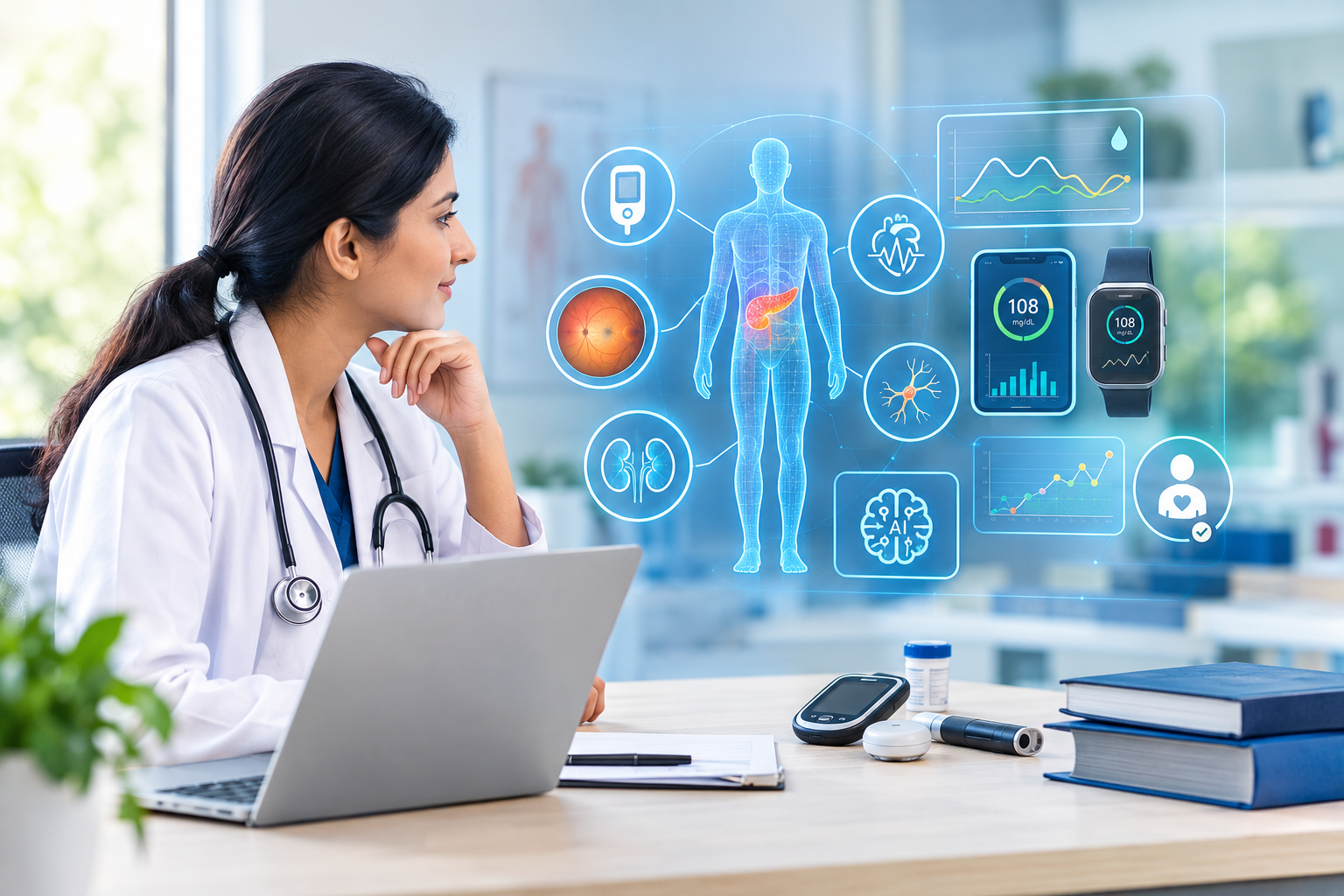
Diabetes has become one of the most significant healthcare challenges in India. With an increasing number of people living with diabetes, doctors need more than general medical knowledge to manage the condition effectively. They must understand its complexities, recognise early warning signs, prevent complications, and provide personalised treatment based on each patient’s needs.
At the same time, Artificial Intelligence (AI) is changing how healthcare professionals identify health risks, monitor patients, interpret medical data, and make clinical decisions. From AI-assisted retinal screening to continuous glucose monitoring systems, technology is creating new opportunities to improve diabetes management.
For doctors looking to strengthen their expertise, combining specialised training through a PG Program in Diabetology with practical AI skills can be a valuable step towards preparing for the future of healthcare.
Why Specialised Training in Diabetology Matters
Diabetes management involves much more than prescribing medication or checking blood glucose levels. Doctors must understand the different types of diabetes, the relationship between lifestyle and metabolic health, and the long-term effects of uncontrolled blood sugar.
Patients may develop complications affecting the eyes, kidneys, nerves, heart, and blood vessels. Effective management requires regular assessment, appropriate treatment, patient education, and long-term follow-up.
A PG Program in Diabetology can help eligible doctors develop specialised knowledge in diabetes diagnosis, treatment planning, complication management, and preventive care. It can also strengthen their understanding of insulin therapy, oral antidiabetic medications, lifestyle modification, and the importance of individualised treatment.
For MBBS doctors and practising medical professionals, additional training in diabetology can support professional development and help them respond to the growing need for specialised diabetes care.
However, clinical knowledge is only one part of the changing healthcare landscape. Doctors must also understand how digital tools and AI-supported technologies can contribute to better patient management.
How Artificial Intelligence Is Transforming Diabetes Care
Artificial Intelligence refers to technologies that analyse information, identify patterns, and generate predictions or recommendations. In diabetes care, AI can help healthcare professionals interpret large amounts of patient data and identify risks that may otherwise be difficult to recognise.
Here are some important applications.
1. Early Identification of Diabetes-Related Risks
AI systems can analyse health information such as blood glucose readings, medical history, laboratory results, age, and other relevant risk factors to identify patterns associated with diabetes and its complications.
These tools may help clinicians identify patients who need further assessment or closer monitoring. For example, AI-assisted retinal screening can help detect signs of diabetic retinopathy, a complication that can threaten vision if left untreated.
AI does not replace diagnostic responsibility. Its findings must be interpreted within the patient’s clinical context, and appropriate medical assessment remains essential.
2. Smarter Glucose Monitoring
Continuous glucose monitoring (CGM) devices measure glucose levels throughout the day and night, providing information about fluctuations that occasional blood tests may not capture.
When combined with suitable software, AI-supported analytics can help identify glucose patterns, including recurring high or low readings and changes associated with meals, physical activity, or medication.
This information can support more informed discussions between doctors and patients. It may also help clinicians evaluate treatment effectiveness and determine whether a management plan needs adjustment.
Doctors trained in diabetology who understand these technologies will be better positioned to interpret the data and use it appropriately in clinical practice.
3. Personalised Diabetes Management
Diabetes affects every patient differently. Two people with similar glucose readings may have different medical histories, lifestyles, treatment requirements, and risks of complications.
AI-based tools can help organise patient information and identify patterns that support personalised care. Depending on the system, they may assist with analysing glucose trends, reviewing adherence patterns, or identifying patients who need follow-up.
For example, a clinician may use glucose records and lifestyle information to discuss why a patient’s readings frequently rise after certain meals.
The final treatment plan must still account for clinical findings, patient preferences, existing conditions, medication safety, and professional judgement. AI can support individualised care, but it should not independently determine treatment without appropriate clinical oversight.
4. Predicting and Preventing Complications
Long-term diabetes can increase the risk of cardiovascular disease, kidney damage, nerve problems, and eye disease.
AI-based models are being developed to identify patterns associated with these complications by analysing clinical records, laboratory results, imaging, and other relevant data.
When appropriately validated, such systems may help healthcare teams prioritise screening and identify patients who require closer follow-up.
For doctors, the ability to understand risk assessment, interpret clinical evidence, and recognise the limitations of predictive models is becoming increasingly valuable.
5. Supporting Remote Diabetes Care
Telemedicine and digital health platforms allow doctors to follow up with patients who may find frequent hospital visits difficult.
Patients can share glucose readings, medication information, and other health measurements through digital systems. AI-enabled tools may help summarise these records or flag unusual patterns for clinical review.
This approach can support continuity of care, particularly for patients who require regular monitoring. Nevertheless, remote monitoring must be supported by appropriate communication, data privacy safeguards, and clear procedures for responding to concerning readings.
Why Doctors Should Combine a PG Program in Diabetology with AI Skills
Specialised medical education and technological awareness complement each other. A doctor who understands diabetes management can better evaluate whether an AI-generated insight is clinically meaningful. Similarly, familiarity with digital tools can help a doctor make better use of patient information.
There are several reasons this combination is worth considering.
Better interpretation of clinical data: Doctors can develop the ability to review glucose trends, laboratory results, and digital health reports more effectively.
Improved understanding of emerging technologies: Familiarity with AI-assisted screening, CGM analytics, and digital patient monitoring helps doctors understand how these tools fit into diabetes care.
More informed clinical decisions: AI-generated insights can provide additional information for assessment, while medical training helps doctors judge their relevance and limitations.
Greater readiness for technology-enabled practice: Hospitals, speciality clinics, and digital health services increasingly use electronic records and remote monitoring systems. Understanding these technologies can help doctors adapt to evolving clinical workflows.
A stronger foundation for lifelong learning: AI is changing rapidly. Doctors who understand its basic principles, evidence requirements, and limitations will be better prepared to evaluate new developments throughout their careers.
Importantly, doctors do not necessarily need to become programmers or data scientists. A practical understanding of AI applications, data interpretation, patient privacy, and responsible technology use can be a useful starting point.
Essential AI Skills for Doctors Interested in Diabetology
Doctors exploring this combination should focus on skills that have direct relevance to patient care.
- Understanding AI fundamentals: Learn what AI and machine learning can do, how predictive models work, and why their results may sometimes be inaccurate.
- Digital glucose data interpretation: Understand CGM reports, glucose trends, time in range, and patterns of glucose variability.
- AI-assisted screening awareness: Become familiar with applications such as diabetic retinopathy screening and their clinical limitations.
- Digital patient monitoring: Understand how telemedicine, electronic health records, and remote monitoring platforms support follow-up.
- Data privacy and ethical practice: Learn how patient information should be handled securely and how consent, confidentiality, and bias affect AI use.
- Evidence-based evaluation: Assess whether an AI tool has been appropriately validated for the intended patient population and clinical setting.
These skills should complement sound medical judgement rather than encourage blind dependence on automated recommendations.
Career Opportunities After Specialised Training in Diabetology
A PG Program in Diabetology can help eligible doctors strengthen their professional profile and explore opportunities related to diabetes care. Depending on their qualifications, clinical experience, local requirements, and the nature of the role, potential pathways may include:
- Diabetes-focused clinical practice.
- Diabetes clinics and multidisciplinary metabolic care services.
- Hospital-based diabetes management.
- Chronic disease management and preventive healthcare.
- Telemedicine and digital diabetes care services.
- Clinical education, research, and healthcare technology initiatives.
AI awareness may be particularly useful in technology-enabled healthcare environments where clinicians work with digital records, remote monitoring platforms, and AI-assisted clinical tools.
However, career outcomes depend on several factors, including recognised qualifications, clinical competence, experience, and applicable professional regulations. Completing a programme does not automatically guarantee a particular position, salary, or specialist designation.
Doctors should also verify the programme’s eligibility criteria, awarding institution, recognition, and scope before enrolling.
Will AI Replace Doctors in Diabetes Care?
AI may automate selected tasks, analyse data quickly, and support screening or risk assessment. However, diabetes care requires much more than data analysis.
Doctors must understand a patient’s medical history, evaluate symptoms, consider multiple health conditions, explain treatment options, and make decisions that reflect individual circumstances. They must also build trust, address patient concerns, and help people maintain long-term lifestyle changes.
These responsibilities require clinical reasoning, communication, empathy, and accountability.
The more realistic future is one in which doctors and AI-supported systems work together. Technology can help clinicians access and interpret information, while doctors remain responsible for clinical decisions and patient care.
The goal is not to replace medical expertise with AI. It is to use suitable technology to strengthen that expertise.
How AIHMS Can Support Your Learning Journey
For doctors interested in developing their knowledge of diabetes management, specialised postgraduate education can provide a foundation for understanding the clinical challenges associated with diabetes.
The Athar Institute of Health and Management Studies (AIHMS) offers a PG Diploma in Diabetology for eligible medical professionals interested in developing their knowledge in this field.
Doctors considering the programme can explore its curriculum, eligibility requirements, and other course details before making an informed decision. They can also pursue independent learning about AI applications in healthcare to understand how digital technologies are influencing modern diabetes management.
Explore the programme here: https://www.aihms.in/PG-Diploma-in-Diabetology.html
As AI continues to develop, combining strong clinical foundations with an understanding of digital healthcare can help doctors prepare for changing professional demands.
Conclusion
The future of diabetes care will depend on the effective combination of medical expertise, preventive healthcare, patient education, and responsible technological innovation.
A PG Program in Diabetology can help doctors deepen their understanding of diabetes diagnosis, treatment, and complication prevention. Adding practical AI knowledge can further help them interpret digital health data, understand emerging screening technologies, and participate more confidently in technology-enabled care.
For MBBS doctors and practising clinicians looking to strengthen their knowledge, this combination offers a meaningful direction for professional development.
The doctors best prepared for the future will not necessarily be those who use the most technology, but those who know when, why, and how to use it responsibly for better patient care.
