
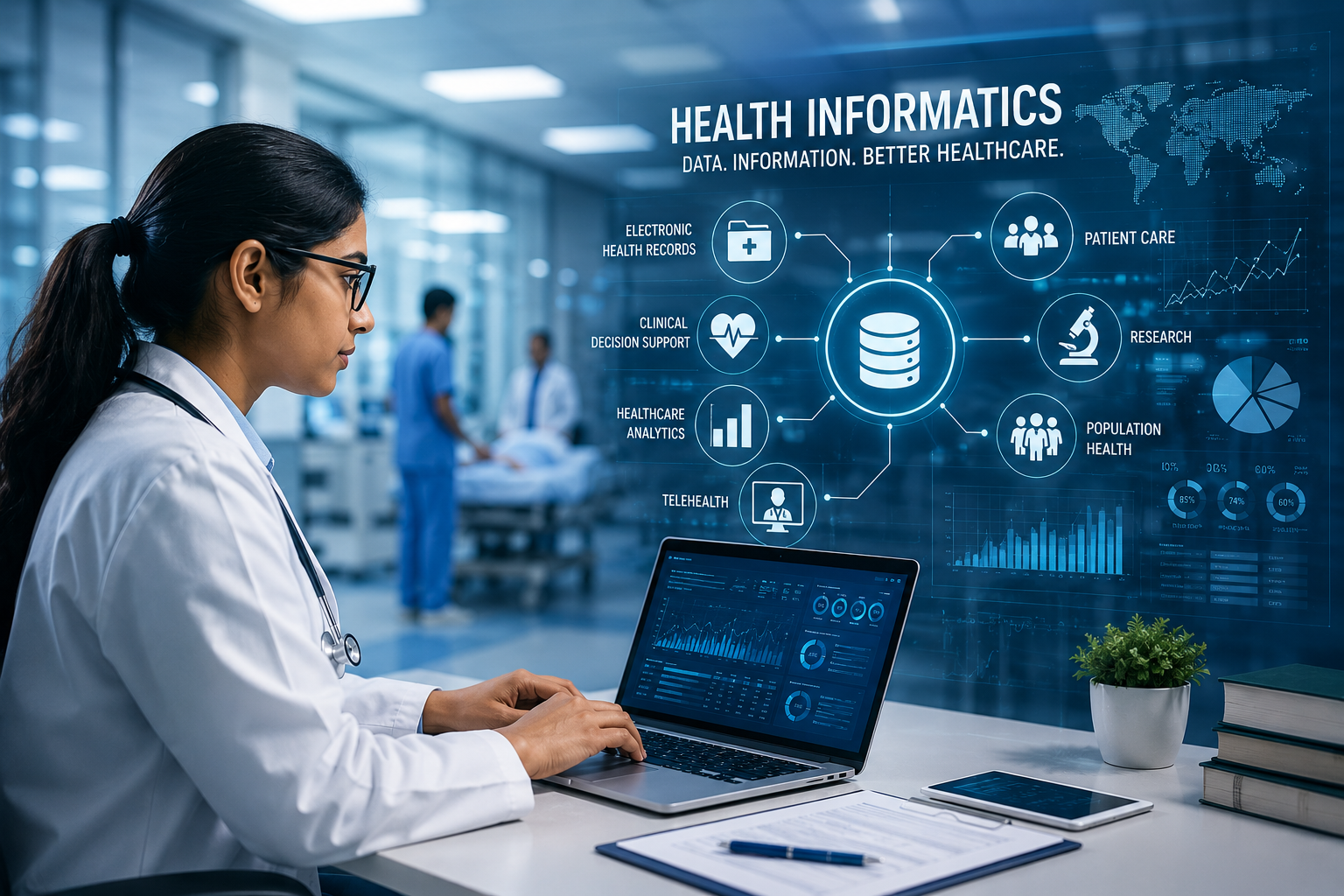
Healthcare is changing faster than ever before. Hospitals are no longer dependent only on doctors, nurses, medical equipment, and physical patient files. Every day, healthcare organizations generate enormous amounts of digital information—from electronic health records and laboratory reports to medical imaging, prescriptions, insurance data, and patient outcomes.
Someone needs to manage, organize, analyze, and use all this information effectively.
That is where Health Informatics comes in.
Health informatics sits at the intersection of healthcare, information technology, data, and management. It helps healthcare organizations turn information into something useful for better patient care, efficient hospital operations, research, and decision-making.
As hospitals continue adopting digital systems, health informatics is emerging as an exciting career field for people who want to work in healthcare without necessarily following a traditional clinical career path.
But what exactly is health informatics? What does a health informatics professional do? What skills are required, and what career opportunities are available?
Let’s explore.
What Is Health Informatics?
Health Informatics is the use of information technology, data, and digital systems to collect, manage, analyze, and use health information.
In simple terms, it connects healthcare with technology.
A hospital generates information at almost every stage of patient care. A patient registers at the reception, visits a doctor, undergoes laboratory tests, receives medicines, gets imaging studies, makes payments, and may return for follow-up treatment.
Health informatics helps ensure that the information generated during these processes is properly recorded, connected, accessible, and useful.
It can involve areas such as:
- Electronic health records
- Hospital information systems
- Health data analytics
- Clinical decision-support systems
- Medical databases
- Digital health platforms
- Telemedicine
- Healthcare interoperability
- Health information management
- Healthcare cybersecurity
- Artificial intelligence in healthcare
- Public health information systems
This makes health informatics a multidisciplinary field rather than simply an IT job.
Why Is Health Informatics Becoming Important?
The healthcare industry is producing more digital information than ever.
Modern hospitals use technology for appointment scheduling, electronic medical records, laboratory management, pharmacy operations, billing, radiology, insurance processing, inventory management, quality monitoring, and many other activities.
At the same time, healthcare organizations are becoming increasingly interested in using data to answer important questions.
For example:
- Which departments are experiencing the highest patient volume?
- How long are patients waiting for treatment?
- Which treatments are producing better outcomes?
- Where are hospital-acquired infections increasing?
- How efficiently are hospital beds being used?
- Which patients may require closer monitoring?
- How can healthcare costs be controlled?
- Where can hospital processes be improved?
Health informatics professionals help organizations find answers to these questions by working with healthcare data and digital systems.
Health Informatics vs Health Information Technology
The terms health informatics and health information technology (health IT) are often used together, but they are not exactly the same.
Health IT generally focuses more on the technology infrastructure used to store, process, and exchange healthcare information.
Health informatics has a broader focus. It looks at how information, people, processes, and technology can work together to improve healthcare.
For example, installing an electronic health record system is primarily a technology project.
Determining how doctors should use that system, how patient information should flow between departments, how data can improve clinical decisions, and how the system can support better outcomes involves health informatics.
This is why health informatics professionals often work between healthcare teams and technology teams.
What Does a Health Informatics Professional Do?
The exact responsibilities depend on the organization and job title.
A health informatics professional may work with healthcare data, digital systems, hospital workflows, reporting, technology implementation, or quality improvement.
Typical responsibilities can include:
Managing Healthcare Data
Health informatics professionals help ensure that healthcare information is accurate, organized, accessible, and appropriately managed.
Supporting Electronic Health Records
Hospitals increasingly depend on digital patient records. Informatics professionals may help implement, maintain, evaluate, or improve electronic health record systems.
Analyzing Healthcare Data
Healthcare data can be converted into useful reports and insights that help administrators and clinicians make better decisions.
Improving Hospital Workflows
Technology should make healthcare processes easier—not create additional problems.
Informatics professionals study workflows and identify opportunities to improve efficiency.
Supporting Digital Transformation
Hospitals introducing new digital technologies need professionals who understand both healthcare operations and technology.
Working With Clinical Teams
Informatics professionals may collaborate with doctors, nurses, pharmacists, administrators, laboratory professionals, and IT teams.
This ability to communicate across different departments is one of the most valuable skills in the field.
Major Areas of Health Informatics
Health informatics is a broad field with several career directions.
Clinical Informatics
Clinical informatics focuses on using information and technology to support clinical care.
Professionals may work with electronic health records, clinical decision-support systems, digital documentation, and healthcare workflows.
Health Information Management
This area focuses on the management, quality, security, and appropriate use of health information.
Healthcare Data Analytics
Healthcare generates enormous datasets. Data analysts use this information to identify trends, measure performance, and support decision-making.
Public Health Informatics
Public health organizations also depend on information systems to monitor diseases, analyze population health, and support health programs.
Nursing Informatics
Nursing informatics combines nursing practice with information management and technology to improve nursing workflows and patient care.
Digital Health
Digital health covers a wide range of technologies, including telemedicine, mobile health applications, remote monitoring, wearable devices, and connected healthcare platforms.
Health Information Exchange
Healthcare information often needs to move between different hospitals, laboratories, clinics, pharmacies, and other organizations.
Health informatics professionals can contribute to systems and processes that enable appropriate information exchange.
Career Opportunities in Health Informatics
One of the biggest advantages of this field is the variety of career paths available.
Depending on their education, experience, and technical skills, professionals may pursue roles such as:
- Health Informatics Specialist
- Health Information Manager
- Clinical Informatics Coordinator
- Healthcare Data Analyst
- Health Data Manager
- Healthcare IT Consultant
- Clinical Systems Analyst
- Electronic Health Records Specialist
- Digital Health Specialist
- Health Information Systems Manager
- Healthcare Business Intelligence Analyst
- Public Health Informatics Specialist
- Healthcare Technology Project Manager
- Clinical Data Analyst
- Health Informatics Consultant
The job title can vary considerably between hospitals, healthcare companies, technology organizations, research institutions, insurance companies, and government organizations.
Where Can Health Informatics Professionals Work?
Health informatics is not limited to hospitals.
Potential workplaces include:
Hospitals and Healthcare Networks
Large hospitals need professionals who can manage digital systems, analyze operational data, and support technology implementation.
Diagnostic Laboratories
Laboratories generate large quantities of clinical information and depend on digital systems for managing tests and reports.
Health Insurance Companies
Insurance organizations use healthcare data for claims processing, utilization management, fraud detection, and healthcare analytics.
Pharmaceutical and Biotechnology Companies
Health data can support clinical research, drug development, safety monitoring, and market analysis.
Healthcare Technology Companies
Companies developing hospital software, electronic health records, telemedicine platforms, and healthcare analytics solutions need professionals who understand healthcare processes.
Government and Public Health Organizations
Health informatics can support disease surveillance, health programs, population health monitoring, and healthcare planning.
Research Institutions
Researchers depend on reliable healthcare datasets for clinical and population health studies.
How Artificial Intelligence Is Changing Health Informatics
Artificial intelligence is adding another dimension to health informatics.
AI can help analyze large datasets, identify patterns, support clinical decision-making, automate repetitive tasks, and assist with predictive analytics.
For example, healthcare organizations may use AI-supported systems to identify patients who could be at higher risk of certain complications or to analyze operational patterns within a hospital.
However, AI does not eliminate the need for health informatics professionals.
In fact, the growing use of AI creates new responsibilities.
Healthcare organizations still need professionals who understand:
- Data quality
- Clinical workflows
- Privacy and security
- System implementation
- AI limitations
- Human oversight
- Ethical use of healthcare data
- Interpretation of analytical results
The future may therefore involve professionals who understand healthcare + data + technology + AI, rather than technology alone.
Is Health Informatics a Good Career for Doctors?
Yes, it can be an interesting career direction for doctors who are interested in healthcare technology, data, systems, research, or healthcare management.
A doctor already understands clinical workflows and patient care. Adding knowledge of information systems and data can open opportunities in areas such as clinical informatics, digital health, healthcare technology, medical data analysis, and healthcare transformation.
Doctors do not necessarily need to become software developers.
Their clinical knowledge can be particularly valuable when working with technology teams because they understand how digital systems affect real-world patient care.
Is Health Informatics Suitable for Hospital Administration Students?
Health informatics can be particularly relevant to students pursuing Hospital Administration and Healthcare Management.
A modern hospital administrator is expected to understand more than staffing, finance, and daily operations.
Digital systems influence almost every part of hospital management.
Hospital administrators may need to understand:
- Hospital Information Systems
- Electronic Medical Records
- Hospital dashboards
- Patient data
- Quality indicators
- Bed occupancy data
- Healthcare analytics
- Digital patient services
- Data privacy
- Technology implementation
This is why knowledge of health informatics can complement a background in hospital administration.
Skills Needed for a Career in Health Informatics
You do not need to be an expert programmer to enter health informatics, but a combination of healthcare, analytical, communication, and technology skills can be extremely valuable.
1. Understanding of Healthcare
You should understand basic healthcare processes and how hospitals and healthcare organizations operate.
2. Data Analysis
The ability to understand spreadsheets, dashboards, statistics, and healthcare datasets is increasingly useful.
3. Knowledge of Healthcare Information Systems
Understanding how HIS, EMR, EHR, laboratory systems, pharmacy systems, and other digital platforms work can give candidates an advantage.
4. Communication Skills
Informatics professionals often act as a bridge between healthcare professionals and IT teams.
Clear communication is therefore essential.
5. Problem-Solving
Healthcare technology projects rarely involve technology alone. Workflow, staffing, training, and organizational challenges must also be addressed.
6. Data Privacy and Security Awareness
Healthcare information is highly sensitive. Professionals working with health data need to understand privacy, security, access control, and responsible data handling.
7. Project Management
Large healthcare technology implementations involve multiple departments, timelines, budgets, vendors, and stakeholders.
Project management skills can therefore be extremely useful.
Do You Need Coding Skills?
This is one of the most common questions about health informatics.
The answer is not necessarily.
Some informatics roles may require programming, database management, SQL, data science, or advanced technical skills.
Other roles focus more on healthcare operations, system implementation, data interpretation, workflow improvement, or project coordination.
For example, a healthcare data analyst may benefit from stronger analytical and technical skills, while a clinical systems coordinator may focus more heavily on healthcare workflows and system implementation.
Therefore, the technical skills required depend on the specific career path.
Learning basic concepts of databases, analytics, and technology can still be highly beneficial even when advanced programming is not required.
Health Informatics and Healthcare Management: A Powerful Combination
Healthcare organizations increasingly need professionals who can understand both management and technology.
Consider a hospital that introduces a new digital patient management system.
An IT professional may understand the software.
A doctor may understand clinical requirements.
A hospital administrator may understand operational and management requirements.
A health informatics professional can help connect these different perspectives.
This ability to bridge departments is one of the reasons health informatics is becoming increasingly relevant to healthcare management.
What Is the Future of Health Informatics?
The future of health informatics is closely connected with the broader digital transformation of healthcare.
Several developments are likely to influence the field.
Artificial Intelligence
AI will increasingly be incorporated into healthcare analytics, clinical support, administrative automation, and research.
Remote Patient Monitoring
Connected devices and wearable technologies are generating more health information outside traditional hospitals.
Telemedicine
Virtual healthcare creates new information flows that need to be managed effectively.
Healthcare Analytics
Hospitals are becoming more interested in using data to improve patient outcomes and operational performance.
Interoperability
Different healthcare systems need to communicate with each other so that information can move appropriately across care settings.
Personalized Healthcare
As healthcare becomes more data-driven, information systems may increasingly support personalized approaches to prevention, diagnosis, and treatment.
Digital Public Health
Population-level health information will continue to play an important role in disease surveillance and public health planning.
These developments suggest that health informatics will remain closely connected to the future of healthcare technology.
How to Start a Career in Health Informatics
There is no single route into health informatics.
Professionals can enter the field from different backgrounds, including:
- Medicine
- Nursing
- Pharmacy
- Public Health
- Hospital Administration
- Healthcare Management
- Information Technology
- Data Analytics
- Life Sciences
A healthcare professional can add technology and data skills.
Similarly, an IT professional can develop knowledge of healthcare systems and workflows.
The right path depends on your existing education and career goals.
Students interested in healthcare management can also build their understanding of health information systems, healthcare analytics, digital transformation, and hospital operations during their academic journey.
Why Health Informatics Could Be One of Healthcare’s Important Careers
Healthcare is becoming increasingly dependent on information.
A hospital cannot operate efficiently if patient information is inaccurate. A public health program cannot be effectively evaluated without reliable data. A healthcare organization cannot make informed decisions if its information remains scattered across disconnected systems.
Health informatics addresses this challenge.
It brings together people, healthcare processes, data, and technology.
That makes it particularly relevant at a time when hospitals and healthcare organizations are moving toward digital platforms, analytics, artificial intelligence, telemedicine, and connected healthcare.
For students and professionals who enjoy healthcare but also have an interest in technology and data, health informatics offers a career path worth exploring.
Frequently Asked Questions About Health Informatics
What is health informatics?
Health informatics is the field that combines healthcare, information, data, and technology to improve healthcare delivery, decision-making, operations, research, and population health.
Is health informatics a good career?
Health informatics can be a promising career for people interested in healthcare technology, data, digital transformation, healthcare management, and information systems.
Can doctors pursue health informatics?
Yes. Doctors can develop careers in areas such as clinical informatics, digital health, healthcare technology, research, and healthcare data.
Can hospital administration students enter health informatics?
Yes. Hospital administration students already learn about healthcare operations and management, and adding knowledge of information systems, analytics, and digital health can broaden their career options.
Does health informatics require coding?
Not every health informatics position requires coding. Some roles require advanced technical skills, while others focus on healthcare systems, data interpretation, workflow improvement, implementation, or management.
What is the difference between health informatics and health information management?
Health informatics generally has a broader focus on using information, data, and technology to improve healthcare, while health information management places strong emphasis on the management, quality, security, and appropriate use of health information.
Where can health informatics professionals work?
They can work in hospitals, diagnostic laboratories, healthcare technology companies, insurance organizations, pharmaceutical companies, research institutions, public health organizations, and other healthcare-related organizations.
Conclusion
The healthcare industry is moving from paper-based processes toward connected, data-driven, and increasingly intelligent systems. As this transformation continues, healthcare organizations will need professionals who understand not only healthcare but also the information and technology behind it.
That is where health informatics stands out.
It offers an opportunity to work at the intersection of healthcare, technology, data, and management. Whether you are a doctor interested in digital healthcare, a hospital administration student looking for a future-focused specialization, a public health professional interested in data, or a technology professional wanting to enter healthcare, health informatics can open several career directions.
The next generation of healthcare will not be driven by technology alone. It will be driven by people who know how to use technology and information to make healthcare work better.
For anyone planning a long-term career in healthcare, understanding health informatics today could be an important investment in tomorrow’s healthcare landscape.
