
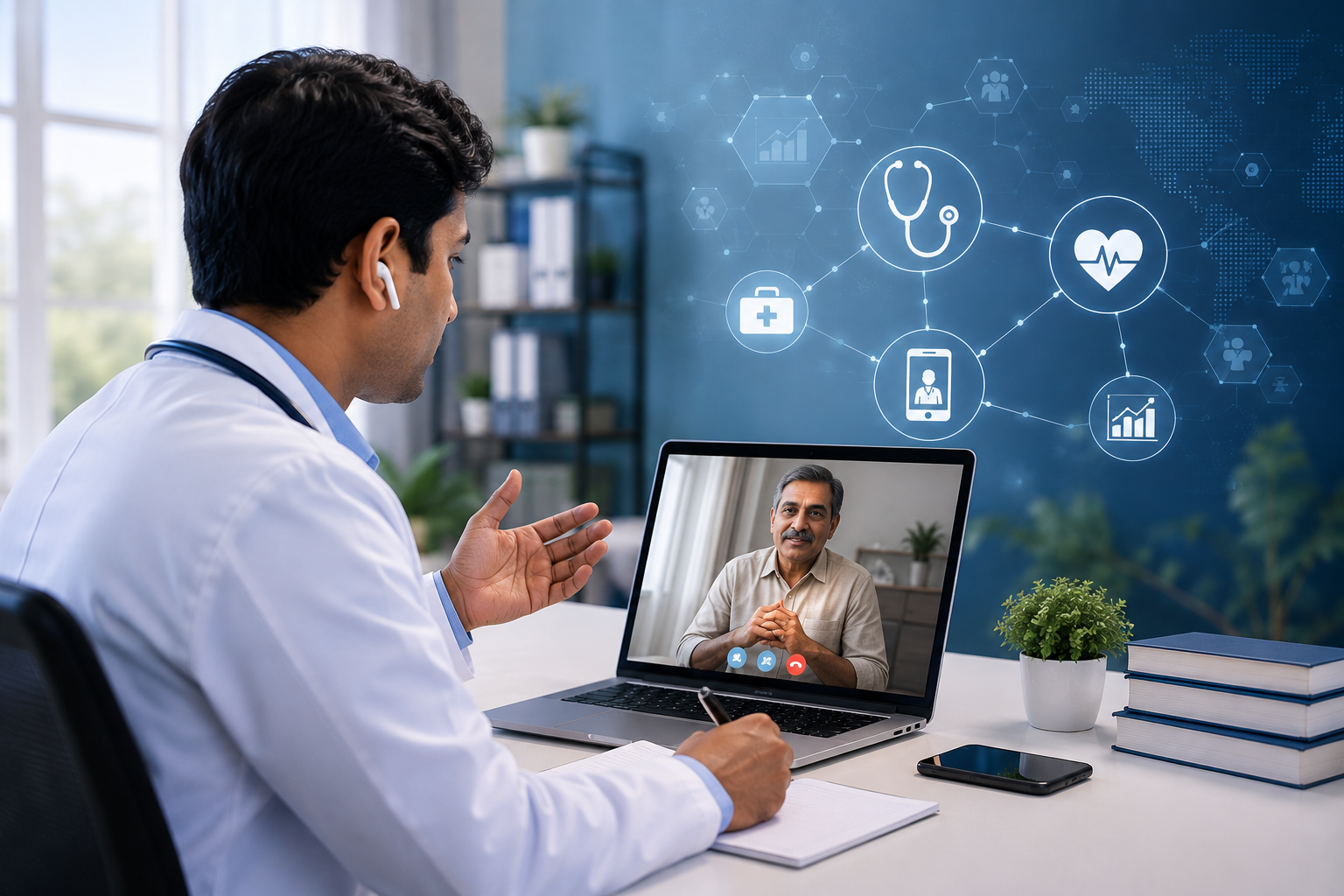
Healthcare delivery is changing. A patient no longer always needs to travel to a hospital or clinic for an initial consultation. Video consultations, remote monitoring, digital prescriptions, online follow-ups, and virtual health platforms are becoming part of everyday healthcare.
For MBBS doctors, this shift has created an interesting question:
Can telemedicine become a career path after MBBS?
The answer is yes—but telemedicine is much broader than simply sitting in front of a camera and consulting patients online.
The growing digital healthcare ecosystem has created opportunities in virtual clinical care, telehealth operations, digital health companies, clinical coordination, healthcare technology, remote patient monitoring, medical content, and healthcare management.
For doctors who want to explore healthcare beyond conventional OPD practice, telemedicine can offer an additional career direction.
In this article, we explore the different telemedicine careers available after MBBS, the skills doctors need, possible work settings, challenges, and how the field could evolve in the coming years.
What Is Telemedicine?
Telemedicine is the delivery of healthcare services through digital communication technologies when the doctor and patient are in different locations.
Depending on the clinical situation and applicable regulations, telemedicine can involve:
- Video consultations
- Audio consultations
- Follow-up consultations
- Remote clinical advice
- Digital prescription services
- Remote monitoring
- Virtual specialist consultations
- Digital health platforms
- Electronic health records
- Tele-triage
- Health education and counselling
Telemedicine does not necessarily replace physical healthcare.
Instead, it can complement conventional healthcare by making certain types of consultations and follow-ups more accessible.
Why Is Telemedicine Creating New Career Opportunities?
Traditional healthcare has always depended heavily on physical facilities. A patient generally had to travel to a clinic or hospital, wait for an appointment, consult a doctor, and return for follow-up.
Digital healthcare can change parts of this process.
A patient living in a smaller town may be able to connect with a specialist located in another city. A patient with a chronic condition may receive certain follow-up services remotely. A hospital can use telemedicine to connect patients with specialists who are not physically available at a particular location.
This creates demand not only for doctors who provide virtual consultations but also for professionals who understand clinical workflows, technology, patient communication, healthcare operations, and digital systems.
Can MBBS Doctors Work in Telemedicine?
Yes. MBBS doctors can explore telemedicine roles where the clinical responsibilities match their qualifications, experience, and applicable professional requirements.
Telemedicine may be particularly relevant for doctors working in:
- Primary care
- General consultations
- Follow-up care
- Preventive healthcare
- Chronic disease management
- Health counselling
- Tele-triage
- Corporate healthcare
- Digital health platforms
- Hospital telehealth services
However, doctors should understand that telemedicine is still medical practice. The same principles of professional responsibility, appropriate clinical assessment, documentation, confidentiality, and patient safety remain important.
Telemedicine should therefore be approached as a healthcare practice supported by technology—not simply as an online job.
Telemedicine Career Options After MBBS
One of the most interesting aspects of telemedicine is that doctors do not have to follow a single career path.
Here are several directions MBBS graduates can explore.
1. Telemedicine Physician
The most direct career option is working as a physician providing remote consultations.
Depending on the organization and service model, doctors may handle:
- General medical consultations
- Follow-up visits
- Basic health concerns
- Preventive health advice
- Chronic disease follow-ups
- Initial assessment and triage
- Referral decisions
This role requires strong communication because the doctor cannot rely on a traditional physical examination in the same way as during an in-person consultation.
2. Tele-Tr iage Doctor
Tele-triage involves assessing patients remotely and determining the appropriate next step.
For example, a patient may contact a healthcare platform with symptoms and need guidance about whether they should:
- Continue home care
- Schedule a consultation
- Visit a clinic
- Go to an emergency department
- Seek specialist evaluation
Doctors working in tele-triage need strong clinical judgement and the ability to recognize situations where remote consultation is not appropriate.
3. Telemedicine Specialist Coordination
Large hospitals and digital healthcare platforms may need doctors to coordinate between patients and specialists.
An MBBS doctor can sometimes work as a clinical coordinator who helps organize consultations, collect relevant information, review documentation, and facilitate communication between patients and specialists.
4. Remote Patient Monitoring
Telemedicine is increasingly connected with remote monitoring.
Patients may use connected devices or digital tools to record health information such as:
- Blood pressure
- Blood glucose
- Heart rate
- Oxygen saturation
- Weight
- Other relevant measurements
Healthcare teams can monitor these data remotely and identify situations requiring further attention.
Doctors with an interest in chronic disease management may find this area particularly interesting.
5. Digital Health Physician
Digital health companies often need doctors who understand both clinical practice and healthcare technology.
A physician may contribute to:
- Digital health product development
- Clinical workflows
- Patient journeys
- Medical content
- Clinical protocols
- Healthcare technology implementation
- Product validation
This career path can be particularly attractive to doctors interested in healthcare innovation.
6. Telemedicine Medical Advisor
Healthcare organizations may employ doctors as medical advisors to provide clinical input into digital healthcare services.
Responsibilities can include reviewing medical content, developing clinical guidelines, evaluating healthcare products, and supporting clinical teams.
7. Clinical Operations in Telehealth
Telemedicine platforms require operational systems behind the consultation screen.
Doctors with an interest in management can move toward roles involving:
- Clinical operations
- Telehealth workflow design
- Quality improvement
- Provider management
- Clinical training
- Service monitoring
- Patient experience
This is where medical knowledge and healthcare management skills can complement each other.
8. Corporate Telehealth
Organizations increasingly provide healthcare services to employees.
Doctors may work with corporate healthcare programs involving:
- Primary consultations
- Preventive health
- Lifestyle counselling
- Chronic disease management
- Employee wellness
- Health screening
This can be another avenue for doctors interested in structured healthcare delivery outside traditional clinical practice.
Telemedicine and Family Medicine
Telemedicine has a natural connection with primary healthcare and family medicine.
Family physicians often manage a broad range of common conditions and provide continuing care. Many follow-up consultations can potentially be conducted remotely when clinically appropriate.
Telemedicine can therefore support:
- Chronic disease follow-up
- Medication review
- Lifestyle counselling
- Preventive care
- Family health discussions
- Routine follow-ups
- Health education
Doctors interested in primary healthcare may find that combining Family Medicine + digital health skills creates a valuable professional profile.
Telemedicine and Chronic Disease Management
Chronic diseases often require regular follow-up rather than a completely new physical consultation at every visit.
Conditions such as diabetes and hypertension require ongoing monitoring, lifestyle modification, medication management, and periodic evaluation.
Telemedicine can support some components of this continuing care.
For example, a patient may share relevant health measurements remotely and discuss progress with a healthcare professional.
However, remote care has limitations, and patients may still require physical examinations, laboratory investigations, imaging, or in-person assessment.
What Skills Do Doctors Need for Telemedicine?
Being a good doctor is essential, but telemedicine also requires some additional skills.
Strong Communication
In a virtual consultation, doctors need to communicate clearly and efficiently.
They should be able to:
- Ask focused questions
- Explain medical information simply
- Listen carefully
- Confirm patient understanding
- Identify warning signs
- Communicate limitations of remote assessment
Digital Literacy
Doctors should be comfortable using:
- Video consultation platforms
- Electronic health records
- Digital prescription systems
- Patient portals
- Remote monitoring tools
- Healthcare applications
Clinical Decision-Making
Remote consultations can provide less information than a physical examination.
Doctors therefore need to recognize when available information is sufficient and when an in-person evaluation is necessary.
Documentation
Accurate documentation is essential in any healthcare setting, including telemedicine.
Doctors should maintain appropriate records of consultations, clinical findings, advice, prescriptions, referrals, and follow-up plans.
Patient Privacy Awareness
Digital consultations involve sensitive health information.
Doctors should understand basic principles of confidentiality, secure communication, appropriate access, and responsible handling of patient information.
Time Management
Online consultations can become inefficient if appointments are not structured properly.
Good time management helps maintain quality while handling multiple patients.
Do Telemedicine Doctors Need Special Training?
Telemedicine is not simply a different location for the same consultation. The digital environment creates specific practical considerations.
Doctors should become familiar with:
- Teleconsultation workflows
- Digital documentation
- Patient identity and consent processes
- Communication techniques
- Remote assessment limitations
- Referral and escalation
- Data privacy
- Technology troubleshooting
- Appropriate use of digital tools
Doctors should also remain aware of the professional and regulatory requirements applicable to telemedicine practice in the jurisdiction where they work.
In India, doctors should refer to the applicable guidance from the Telemedicine Practice Guidelines and current professional and regulatory requirements rather than relying on outdated online advice.
Advantages of Telemedicine Careers After MBBS
Telemedicine can offer several advantages depending on the role and employer.
Wider Patient Reach
Doctors can potentially provide services to patients who may otherwise have difficulty accessing healthcare.
Flexible Work Models
Some telemedicine organizations offer remote or hybrid work arrangements, depending on the position.
Exposure to Digital Healthcare
Doctors can gain experience with electronic records, virtual care platforms, remote monitoring, and healthcare technology.
Multiple Career Directions
Telemedicine can lead toward clinical practice, digital health, operations, healthcare management, technology, or entrepreneurship.
Opportunity to Develop New Skills
Doctors can build expertise beyond traditional clinical practice, particularly in digital health and healthcare management.
Challenges of Telemedicine
Telemedicine also has limitations.
Limited Physical Examination
A remote consultation cannot always replace an in-person examination.
Technology Problems
Poor internet connections, audio issues, device problems, or platform failures can affect consultations.
Privacy Concerns
Healthcare organizations must take appropriate steps to protect patient information.
Clinical Limitations
Some conditions require laboratory testing, imaging, procedures, or physical examination.
Communication Difficulties
Non-verbal cues may be harder to interpret during a virtual consultation.
Patient Expectations
Some patients may expect a remote consultation to provide the same level of assessment as a physical visit, which may not always be possible.
Understanding these limitations is essential for safe and responsible telemedicine practice.
Telemedicine vs Traditional Clinical Practice
Telemedicine and physical practice should not necessarily be viewed as competitors.
They can complement one another.
| Telemedicine | Traditional Consultation |
|---|---|
| Remote access | Physical presence |
| Digital communication | Face-to-face communication |
| Convenient for suitable cases | Better for physical examination |
| Can support follow-ups | Suitable for procedures and detailed examination |
| Technology dependent | Less dependent on internet connectivity |
| Wider geographic reach | Requires patient travel |
The appropriate model depends on the patient’s condition and clinical requirements.
Telemedicine and Artificial Intelligence
Artificial intelligence is likely to become increasingly important in digital healthcare.
AI-powered systems may assist with:
- Patient triage
- Documentation
- Clinical decision support
- Appointment scheduling
- Medical information retrieval
- Data analysis
- Remote monitoring
- Administrative automation
However, AI does not eliminate the need for doctors.
Clinical judgement, communication, accountability, patient context, and ethical decision-making remain important.
Doctors who understand both clinical practice and digital technologies may therefore be well positioned as healthcare becomes increasingly technology-driven.
Career Opportunities Beyond Teleconsultation
One of the biggest misconceptions about telemedicine is that every career involves conducting video consultations.
The broader digital health ecosystem offers many other opportunities.
An MBBS graduate may explore roles related to:
- Digital health
- Healthcare technology
- Clinical operations
- Medical content
- Health informatics
- Healthcare analytics
- Telehealth management
- Remote patient monitoring
- Clinical product development
- Healthcare quality
- Medical affairs
- Healthcare consulting
This makes telemedicine relevant even for doctors who eventually decide not to work as full-time online clinicians.
Can Telemedicine Lead to Healthcare Management?
Yes.
Doctors who become interested in how digital healthcare services are designed and managed may eventually move toward healthcare management roles.
They may become involved in:
- Telehealth operations
- Clinical quality
- Provider management
- Patient experience
- Digital transformation
- Healthcare technology implementation
- Service development
This is one reason a background in Hospital Administration or Healthcare Management can complement clinical experience.
How to Build a Career in Telemedicine After MBBS
If you’re an MBBS graduate interested in telemedicine, consider developing your career in stages.
Step 1: Strengthen Your Clinical Foundation
A strong understanding of clinical medicine remains the foundation of safe telemedicine practice.
Step 2: Learn Digital Healthcare
Understand how telemedicine platforms, electronic health records, digital prescriptions, remote monitoring, and healthcare information systems work.
Step 3: Improve Communication Skills
Practice explaining clinical information clearly in a virtual environment.
Step 4: Understand Telemedicine Guidelines
Stay updated with the professional and regulatory requirements applicable to your practice.
Step 5: Explore Different Career Models
Look beyond online consultation jobs. Explore digital health companies, hospitals, telehealth operations, healthcare technology, and clinical coordination.
Step 6: Consider Additional Healthcare Education
Doctors interested in moving toward management, public health, family medicine, or digital healthcare can consider additional postgraduate education based on their career goals.
Is Telemedicine a Good Career Option After MBBS?
For the right person, telemedicine can be a valuable career direction.
It is particularly relevant for doctors who are interested in:
- Digital healthcare
- Primary care
- Healthcare technology
- Flexible care models
- Patient communication
- Healthcare innovation
- Clinical operations
- Healthcare management
However, it should not be viewed as an effortless alternative to traditional medical practice.
Successful telemedicine requires clinical competence, responsible decision-making, communication skills, digital literacy, and an understanding of when remote care is appropriate.
The Future of Telemedicine Careers
Telemedicine is likely to become increasingly integrated with other parts of healthcare rather than existing as a completely separate service.
The future could involve a combination of:
Physical consultation + virtual consultation + remote monitoring + electronic health records + healthcare analytics + AI-supported systems.
Doctors may increasingly work as part of hybrid healthcare teams rather than choosing between “online” and “offline” medicine.
This creates opportunities for professionals who can understand both sides of healthcare.
For MBBS graduates, learning about telemedicine today can therefore provide exposure to a broader transformation that is taking place across the healthcare industry.
Frequently Asked Questions
Can I work in telemedicine after MBBS?
Yes. MBBS doctors can explore appropriate telemedicine roles, including remote consultations, tele-triage, clinical coordination, digital health, and telehealth operations, subject to applicable professional and regulatory requirements.
Is telemedicine a good career after MBBS?
Telemedicine can be a useful career option for doctors interested in digital healthcare, remote patient care, technology, primary care, and flexible healthcare delivery models.
What skills are needed for telemedicine?
Important skills include clinical decision-making, communication, digital literacy, documentation, patient privacy awareness, and the ability to recognize when a patient requires in-person assessment.
Can MBBS doctors work for telemedicine companies?
Yes. Depending on the company’s requirements, MBBS doctors may work in clinical consultation, tele-triage, clinical operations, medical content, digital health, or other healthcare roles.
Can telemedicine replace physical consultations?
No. Telemedicine can complement conventional healthcare, but many conditions require physical examination, diagnostic testing, procedures, or emergency care.
Is telemedicine useful for family medicine?
Yes. Telemedicine can support suitable primary-care and family-medicine activities such as follow-ups, chronic disease management, preventive care, and health counselling.
Will AI replace telemedicine doctors?
AI may automate or assist with certain tasks, but doctors remain important for clinical judgement, patient communication, accountability, and complex decision-making.
Conclusion
Telemedicine is more than online doctor consultations. It is part of a much larger transformation in how healthcare is delivered, managed, and accessed.
For MBBS doctors, this transformation can create opportunities in virtual clinical care, tele-triage, digital health, remote monitoring, clinical operations, healthcare technology, and management.
The most valuable professionals in the future may not simply be those who know how to use a video consultation platform. They may be doctors who understand clinical medicine, digital healthcare, patient needs, data, and healthcare systems together.
If you are an MBBS graduate planning your next career step, telemedicine is worth exploring—but so are the broader fields of Family Medicine, Public Health, Hospital Administration, Health Informatics, and Digital Health.
The future of healthcare is likely to be hybrid, connected, and increasingly digital. Building the right skills today can help doctors participate meaningfully in that future.
